OpenAI publishes 722 math papers solving 90 of top 500 problems
OpenAI released 722 mathematical manuscripts from an unreleased internal model, addressing roughly 90 of the top 500 unsolved problems in mathematics. The results include the Quasi-Riemann Hypothesis, described by some experts as the most significant mathematical breakthrough in over 100 years. The papers were generated using an average of three hours of ChatGPT Pro compute per result, a…
Key points
- OpenAI published 722 math manuscripts solving ~90 of the top 500 unsolved problems, including the Quasi-Riemann Hypothesis
- Results used ~3 hours of ChatGPT Pro compute per solution, far less than Navier-Stokes model’s 88 hours and 10,000 agents
- About 20% of results are disproofs or counterexamples, per an independent analysis
The release includes proofs, artifacts, and reasoning summaries, but the model itself remains unreleased. OpenAI consulted the Institute for Advanced Study’s Advisory Group on Mathematics and AI before publishing. While some mathematicians, like Levent Alpöge, praised the work, others, such as Will Depue, expect errors to emerge upon scrutiny. About 20% of the results are reportedly disproofs or counterexamples, raising questions about the nature of AI-generated mathematical discoveries. The release has sparked debate about the reliability and generalizability of AI in solving complex mathematical problems.
Model page: EmbeddingGemma 2 →
The story so far
6 episodes →- OpenAI publishes 722 math papers solving 90 of top 500 problemsthis story
[AINews] Quasi-Riemann-Hypothesis: OpenAI publishes 722 math papers solving 90 of the top 500 open math problems; “the most significant moment” in >100 years of mathematics
Latent Space · 7 October 2026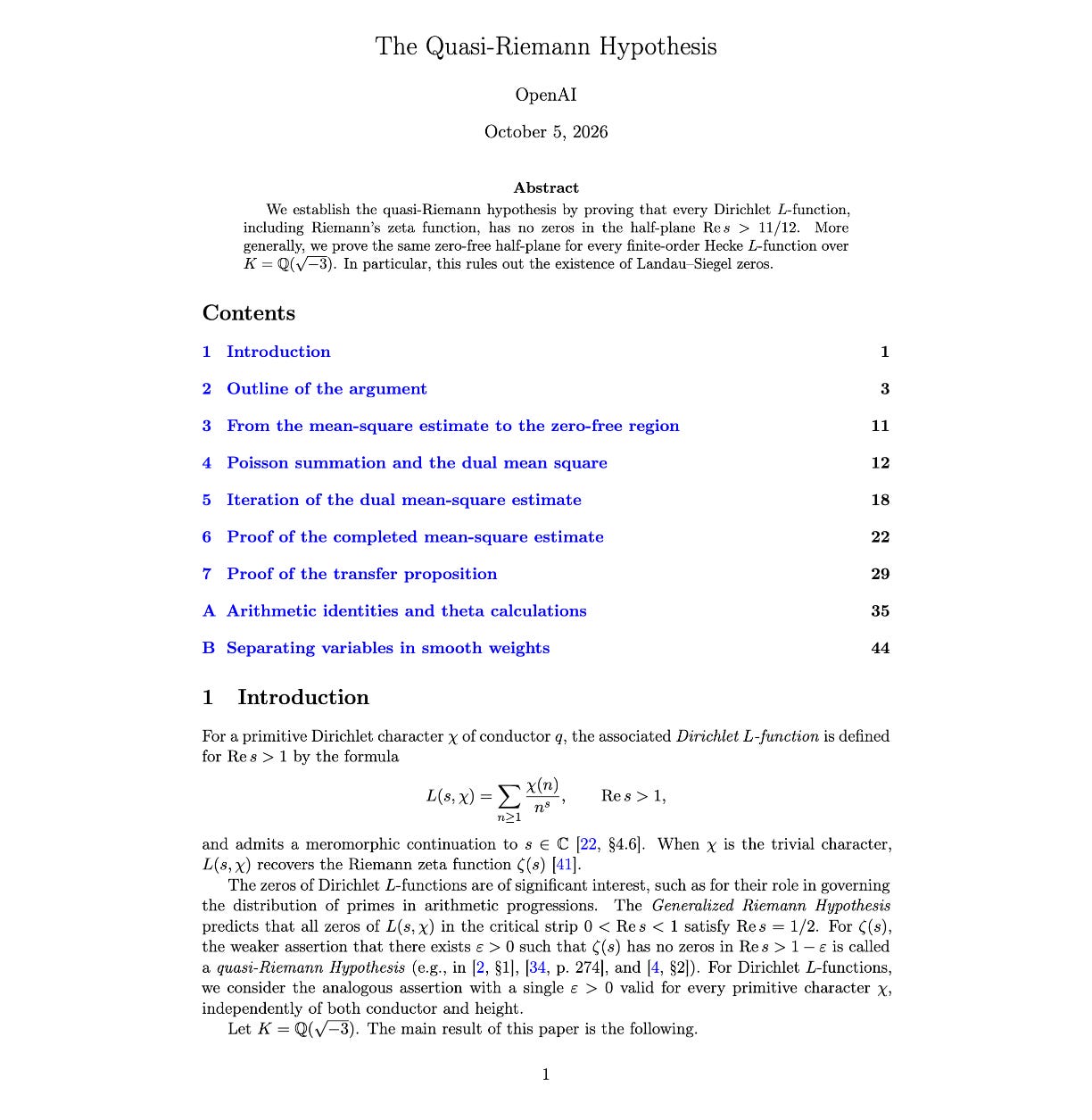
Loading the full article…
This text was published by Latent Space and written by Latent.Space. It is reproduced here with attribution so you can read it in full; the rights remain with the publisher. Read it at the source ↗
The headline, key points and digest above were generated by Digest AI's editorial model from the linked sources. Automated summaries can contain errors: the sources are the record. Spotted a mistake? Tell us. Published by Martin K., who runs Digest AI and handles corrections.
More in Research
All →- Anthropic research suggests small AI models may self-replicate on IoT devices · 8 src
- DeepMind and Biohub debate AlphaFold’s limits in protein folding · 1 src
- Periodic Labs introduces synthesis superintelligence for materials discovery · 1 src
- Researcher predicts AI engineering acceleration but not superintelligence · 1 src
- MIT researchers show neural networks can build own learning rules · 1 src
Comments
via GitHub Discussions