Homelab builder runs 2.8-trillion-parameter Kimi K3 on second-gen Optane memory
A Reddit user has run Moonshot AI's 2.8-trillion-parameter Kimi K3 model on a home system using discontinued Intel Optane PMem 200 memory modules and a 40-core 3rd-gen Xeon Scalable CPU, without any GPU. The build achieves 0.85 tokens per second with 1-bit quantization, dropping to 0.75 tokens per second at 3-bit quantization. The smallest community quantization of Kimi K3 requires at least…
Key points
- Achieves 0.85 tokens/sec at 1-bit quantization, 0.75 at 3-bit
- Optane DIMMs require mandatory active cooling to avoid thermal throttling
The Optane DIMMs run extremely hot during sustained inference, requiring dual 12W blower fans for active cooling to prevent thermal throttling at 83 degrees Celsius. Intel specifies forced airflow of 2.4 to 2.7 meters per second for these modules, typical of data centers but not home setups. Four modules can generate up to 60W of heat adjacent to system DRAM. The builder used App Direct Mode, which exposes Optane as a persistent region for direct tensor mapping, offering more control over memory placement than Memory Mode. Performance figures are pre-tuning, with plans to add GPUs and use DRAM as a faster tier for future benchmarks.
The story so far
5 episodes →- Homelab builder runs 2.8-trillion-parameter Kimi K3 on second-gen Optane memorythis story
Homelabber uses second-gen Optane memory sticks to run a 2.8-trillion-parameter AI model on CPU alone
Tom's Hardware · 8 November 2026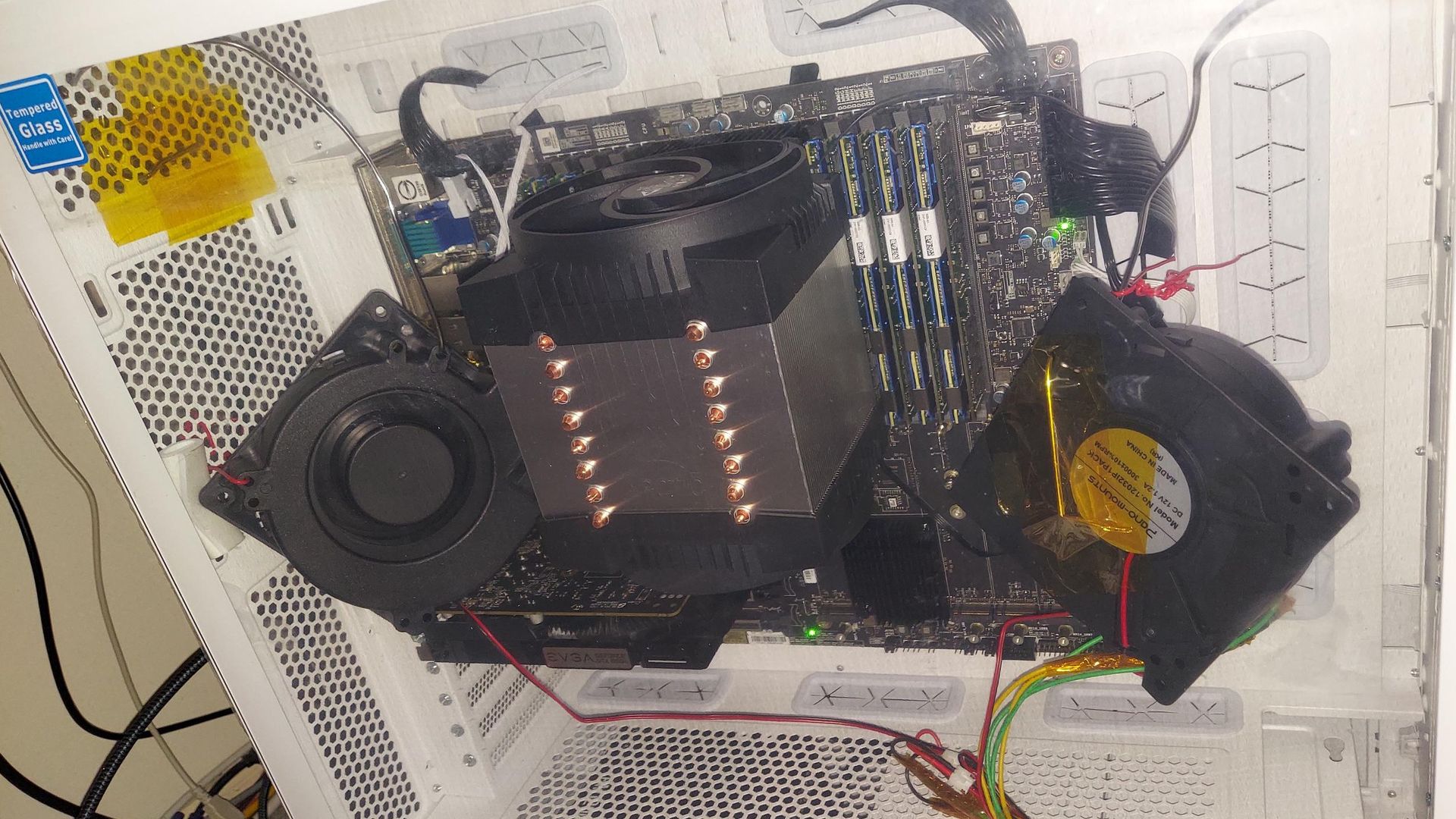
Loading the full article…
This text was published by Tom's Hardware and written by Shane Downing. It is reproduced here with attribution so you can read it in full; the rights remain with the publisher. Read it at the source ↗
The headline, key points and digest above were generated by Digest AI's editorial model from the linked sources. Automated summaries can contain errors: the sources are the record. Spotted a mistake? Tell us. Published by Martin K., who runs Digest AI and handles corrections.
More in Hardware & Compute
All →- Meta reportedly sets Muse Charm price at $300 with free Verizon plan · 4 src
- Marlowe raises $277M seed to build AI inference factories with AMD, Etched · 2 src
- Nvidia powers Paradromics' brain-computer interfaces · 1 src
- Nvidia RTX Spark could boost AI on Asus ProArt P16 · 1 src
- NVIDIA releases Alpamayo 2 Edge for DRIVE Thor · 1 src
Comments
via GitHub Discussions