Homelabber’s second-gen Optane build uses two RTX 3090s to run 2.8-trillion-parameter Kimi AI model at 3.11 tokens per second
The 2.8-trillion-parameter model is quantized to a Q2K file of 865 GB, with 414 GB (45 of 94 shards) placed on a Linux tmpfs RAM drive. Moving those shards from Optane persistent memory to DRAM increased generation speed by 41% and prompt evaluation by 26% compared with the Optane-only configuration. Without the RAM drive, the same GPUs achieved 2.20 tokens per second generation and 13.3 tokens…
Key points
- RAM drive holding 414 GB of model shards adds 41% generation speed and 26% prompt eval speed over Optane alone
- GPUs handle attention, dense layers, shared experts, KV cache; routed experts stay on CPU-side Optane and RAM drive
The story so far
5 episodes →- Homelabber’s second-gen Optane build uses two RTX 3090s to run 2.8-trillion-parameter Kimi AI model at 3.11 tokens per secondthis story
Homelabber’s second-gen Optane build uses two RTX 3090s to run 2.8-trillion-parameter Kimi AI model at 3.11 tokens per second
Tom's Hardware · 21 November 2026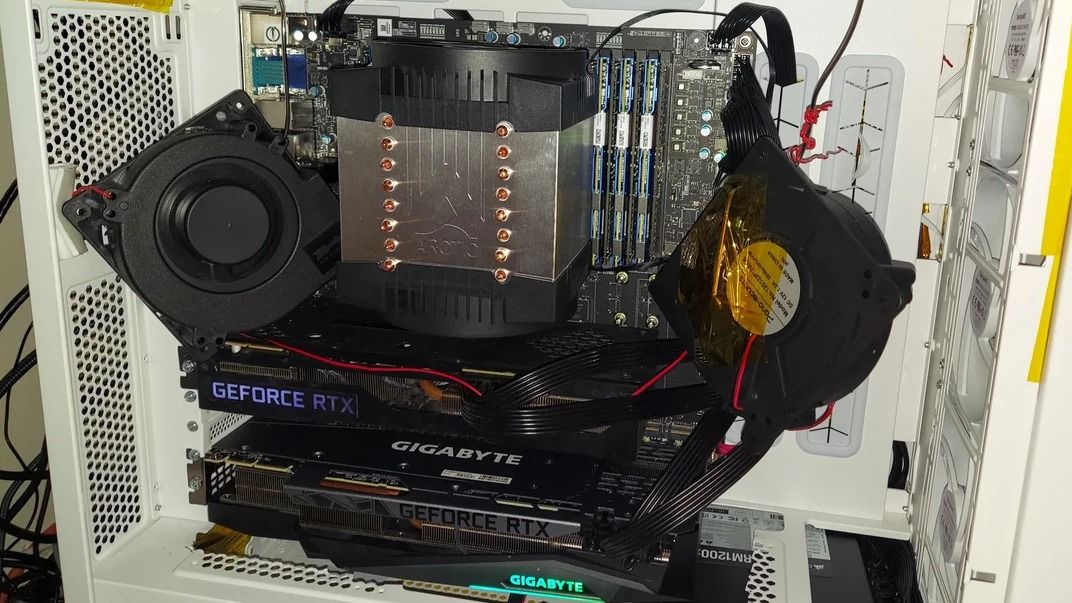
Loading the full article…
This text was published by Tom's Hardware and written by Shane Downing. It is reproduced here with attribution so you can read it in full; the rights remain with the publisher. Read it at the source ↗
The headline, key points and digest above were generated by Digest AI's editorial model from the linked sources. Automated summaries can contain errors: the sources are the record. Spotted a mistake? Tell us. Published by Martin K., who runs Digest AI and handles corrections.
More in Hardware & Compute
All →- Meta reportedly sets Muse Charm price at $300 with free Verizon plan · 4 src
- Marlowe raises $277M seed to build AI inference factories with AMD, Etched · 2 src
- Nvidia powers Paradromics' brain-computer interfaces · 1 src
- Nvidia RTX Spark could boost AI on Asus ProArt P16 · 1 src
- NVIDIA releases Alpamayo 2 Edge for DRIVE Thor · 1 src
Comments
via GitHub Discussions