Huawei limits new Ascend AI chips to China due to capacity constraints
Huawei announced that its upcoming Ascend 960‑series neural processing units will be sold only within China because the company cannot meet domestic demand with its current production capacity. Rotating chairman Eric Xu said at the Huawei Connect conference that the firm may supply limited volumes to a few countries with strong demand, but there is no plan for a full international rollout.
Key points
- Huawei will sell its next‑gen Ascend 960‑series NPUs only in China, citing insufficient capacity for domestic demand.
- The Ascend 960DT aims for 2 PFLOPS FP8 training and 4 PFLOPS FP4 inference; 960PR targets 8 PFLOPS FP4, still below Nvidia’s comparable GPUs.
- Atlas SuperPoDs can pack up to 15,488 NPUs delivering up to 120 EFLOPS FP4, but power efficiency lags Nvidia, limiting export appeal.
The Ascend 960DT and 960PR are projected to reach 2 PFLOPS FP8 training and 4‑8 PFLOPS FP4 inference performance by 2027, with later Ascend 970 and 980 models targeting up to 28 PFLOPS FP4. Even so, benchmark figures place these chips well below Nvidia’s H200, B300 and R200 GPUs. Huawei’s Atlas SuperPoDs, which can house up to 15,488 NPUs and deliver up to 120 EFLOPS FP4, rely on massive system‑level scaling that consumes far more power than competing Nvidia solutions, limiting their attractiveness outside China.
Huawei shelves global AI chip rollout as China's own demand outstrips supply — 15,488-chip Atlas clusters leverage optical networking to counter Nvidia, scales to 120 EFLOPS
Tom's Hardware · 21 September 2026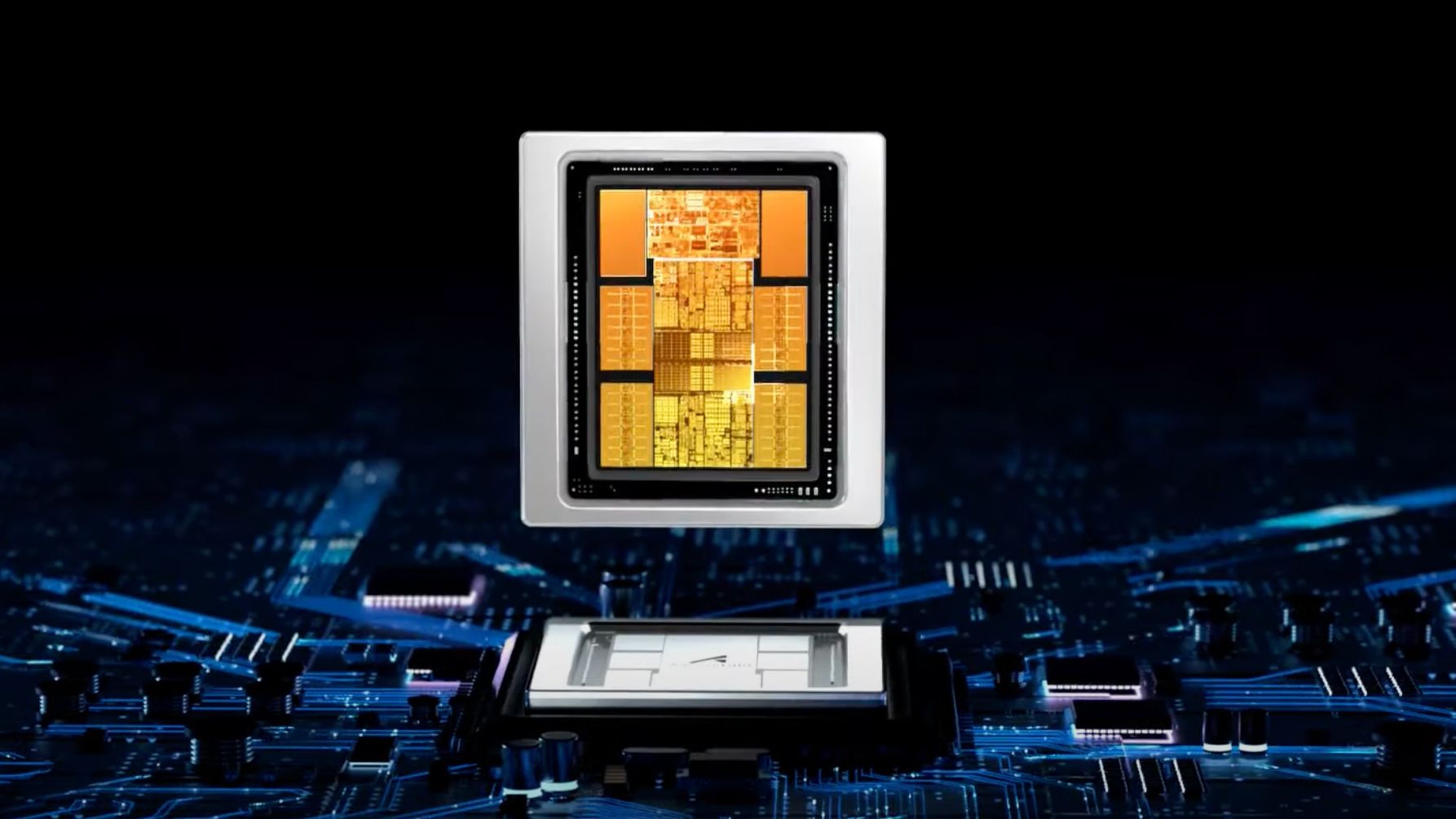
Huawei's impressive next-generation Ascend 900-series AI accelerators will be offered only in China, not internationally, as the company struggles to meet domestic demand amid capacity constraints, the company announced this week. While the upcoming Ascend 960-series neural processing units (NPUs) could rival some of AMD's and Nvidia's existing AI GPUs, demand for these units outside of China was not guaranteed anyway.
"Since we do not have enough capacity to even satisfy the demand in China, we do not have a plan to expand into the international market in a fully-fledged way," said Eric Xu, rotating chairman of Huawei, on the sidelines of the company's Huawei Connect conference, Reuters reports. He added that Huawei supplies limited volumes to 'some countries where demand is particularly strong,' though he did not elaborate.
Huawei this week unveiled its latest AI accelerator roadmap, revealing major training and inference performance gains for its next-generation Ascend 960, 970, and 980 NPUs over the existing Ascend 910C and Ascend 950-series. The Ascend 960DT and 960PR are set to increase their FP8 training performance to 2 PFLOPS and their FP4 inference performance to 4 PFLOPS and 8 PFLOPS, respectively, in 2027. Meanwhile, their successors, Ascend 970 and Ascend 980, are projected to increase their FP4 performance to 14 PFLOPS and 28 PFLOPS, respectively, in the coming years.
Huawei Ascend vs Nvidia AI GPUs
*Preliminary data
S/D - Sparse and Dense
T/I - Training and Inference
But while the upcoming Ascend NPUs will be considerably faster than their predecessors, particularly for inference, they will remain well behind Nvidia's previous- and current-generation accelerators, at least in raw compute performance. Huawei's 2027 Ascend 960DT is projected to deliver 2 FP8 TFLOPS for training, compared with Nvidia's 4 FP8 TFLOPS for the H200, released in 2023. The Ascend 960PR is expected to offer 8 FP4 PFLOPS for training, which is far behind Nvidia's B300, which delivers 15–20 NVFP4 PFLOPS. Even the Ascend 980, targeted for 2029, is projected to reach 7.2 FP8 PFLOPS and 28 FP4 PFLOPS, well below Nvidia's R200, which is on track to deliver 17.5 FP8 PFLOPS and 35/50 FP4 PFLOPS this year.
Such a massive performance difference with leading AI hardware will reinforce Huawei's reliance on massive system-level scaling rather than chip-for-chip performance to compete with Nvidia. But massive system-level scaling comes with massive power consumption, which will make Huawei's next-generation Atlas SuperPoDs and SuperClusters considerably less competitive in markets that can access hardware from AMD or Nvidia.
Huawei is in an interesting paradoxical situation. On the one hand, its integration efforts like near-package optics (NPO) clearly free up capacity on 'older' nodes that can be used for other components of AI platforms. But on the other hand, SMIC's inability to ramp production on 7nm and 6nm-class nodes limits Huawei's ability to supply its AI hardware anyway, which is why it can barely meet demand.
Then again, while Huawei's Atlas SuperPoDs with up to 15,488 Ascend 960 NPUs can deliver up to 30 FP8 EFLOPS and 120 FP4 EFLOPS performance by far exceeding the capabilities of Nvidia's NVL72 clusters with a 72-GPU scale-up world size, their performance-per-watt is poised to be dramatically lower compared to Nvidia's architectures, which means that demand for such hardware outside of China will be limited at best. That said, a global AI hardware push doesn't make much sense for Huawei right now. What perhaps does make sense is offering cloud access to its hardware to various academic and research customers to popularize its CANN software stack.
Anton Shilov is a contributing writer at Tom’s Hardware. Over the past couple of decades, he has covered everything from CPUs and GPUs to supercomputers and from modern process technologies and latest fab tools to high-tech industry trends.
This text was published by Tom's Hardware and written by Anton Shilov. It is reproduced here with attribution so you can read it in full; the rights remain with the publisher. Read it at the source ↗
The headline, key points and digest above were generated by Digest AI's editorial model from the linked sources. Automated summaries can contain errors: the sources are the record. Spotted a mistake? Tell us.
More in Hardware & Compute
All →- Nvidia introduces Halos safety system for autonomous vehicles and robots · 1 src
- Apple and Tesla were better insulated from Hugging Face breach, analysts say · 1 src
- Google launches Googlebook laptops with Android‑ChromeOS hybrid · 3 src
- Opinion: M5 Ultra Mac Studio enables fast local AI agents, reviewer says · 1 src
- Googlebooks are phone-first, not ai-first · 1 src
Comments
via GitHub Discussions