KDnuggets outlines four-stage roadmap for computer Vision engineers
The guide breaks down skills into four stages, starting with spatial mathematics and foundational vision primitives like matrix transformations and projective geometry. It emphasizes hands-on practice with PyTorch for tensor manipulation and Albumentations for synthetic data augmentation, distinguishing between convolutional and attention-based backbones.
Key points
- Four-stage roadmap covers spatial math, ViTs, 3D vision, and edge deployment optimization
- Exercises include stereo depth estimation, open-vocabulary detection, and model quantization
- Frameworks like PyTorch, Albumentations, TensorRT, and ONNX Runtime are emphasized
Later stages cover Vision Transformers (ViTs) and multimodal foundation models such as CLIP, OWL-ViT, and SAM 2, with exercises on open-vocabulary detection. The third stage shifts to 3D vision, neural rendering, and spatial perception, including Depth Anything (v2) for depth estimation and 3D Gaussian Splatting for novel view synthesis. The final stage focuses on inference optimization and edge deployment, detailing techniques like post-training quantization, pruning, and knowledge distillation, alongside frameworks like TensorRT and ONNX Runtime. Portfolio exercises for each stage guide practical implementation, from stereo depth estimation to deploying quantized models on NVIDIA hardware.
The Roadmap to Becoming a Computer Vision Engineer in 2026
KDnuggets · 26 October 2026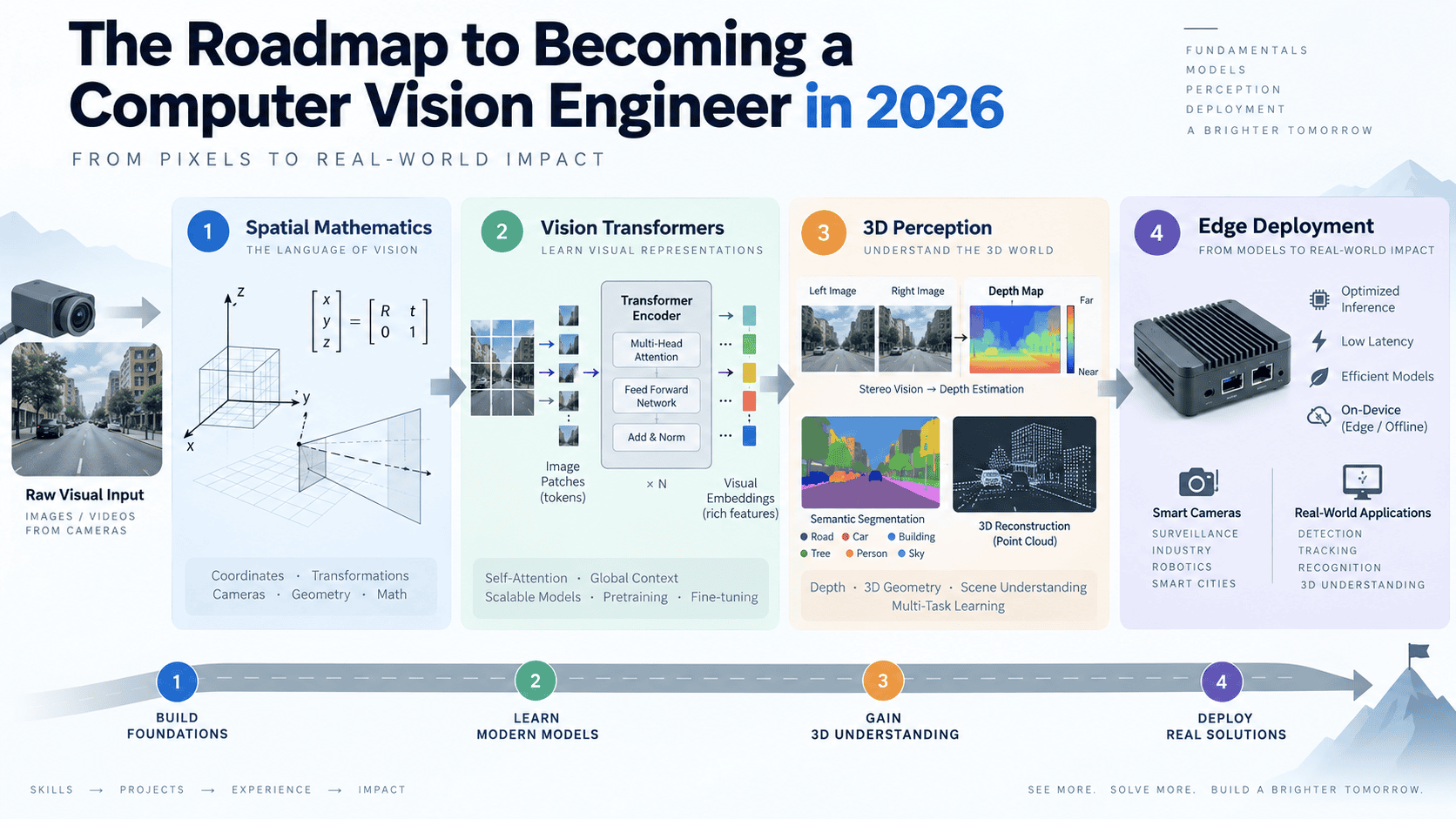
Loading the full article…
This text was published by KDnuggets and written by Vinod Chugani. It is reproduced here with attribution so you can read it in full; the rights remain with the publisher. Read it at the source ↗
The headline, key points and digest above were generated by Digest AI's editorial model from the linked sources. Automated summaries can contain errors: the sources are the record. Spotted a mistake? Tell us. Published by Martin K., who runs Digest AI and handles corrections.
More in Research
All →- iMerit launches Scholars platform to scale expert AI training and evaluation · 1 src
- Machine learning explores quantum superpositions but cannot solve Schrödinger’s cat paradox · 1 src
- Resolution autoformalizes math to speed AI alignment research · 1 src
- Graphite finds ChatGPT still rarely mentions many brands even when using search · 1 src
- Google DeepMind’s AI model predicts Hurricane Isaias’ Florida landfall more accurately than conventional systems · 1 src
Comments
via GitHub Discussions