Kyutai releases CADRE open video autoencoders to reduce world model lag
Kyutai has released CADRE, a family of seven open causal diffusion representation autoencoders designed to reduce action latency in interactive world models.
Key points
- Release includes 7 autoencoder variants, 4 multi-resolution versions, and 4 world models
- Code is MIT licensed while model weights use a non-commercial CC BY-NC 4.0 license
The autoencoders feature approximately 476 million trained parameters alongside a frozen 86 million parameter DINOv3 vision transformer. The release includes code under an MIT license and weights on Hugging Face under a non-commercial CC BY-NC 4.0 license, along with four 1.2 billion parameter world models.
In Kyutai's self-reported benchmarks across driving, robotics, and navigation environments, CADRE models outperformed competing architectures like Wan 2.2, Cosmos, and LTX-2 in 42 of 48 comparisons. However, Wan 2.2 achieved better video reconstruction, and Cosmos outperformed CADRE in certain robot manipulation metrics.
The story so far
2 episodes →- Kyutai releases CADRE open video autoencoders to reduce world model lagthis story
Kyutai CADRE: Video Autoencoders That Cut World Model Lag Below 230 ms
MarkTechPost · 23 October 2026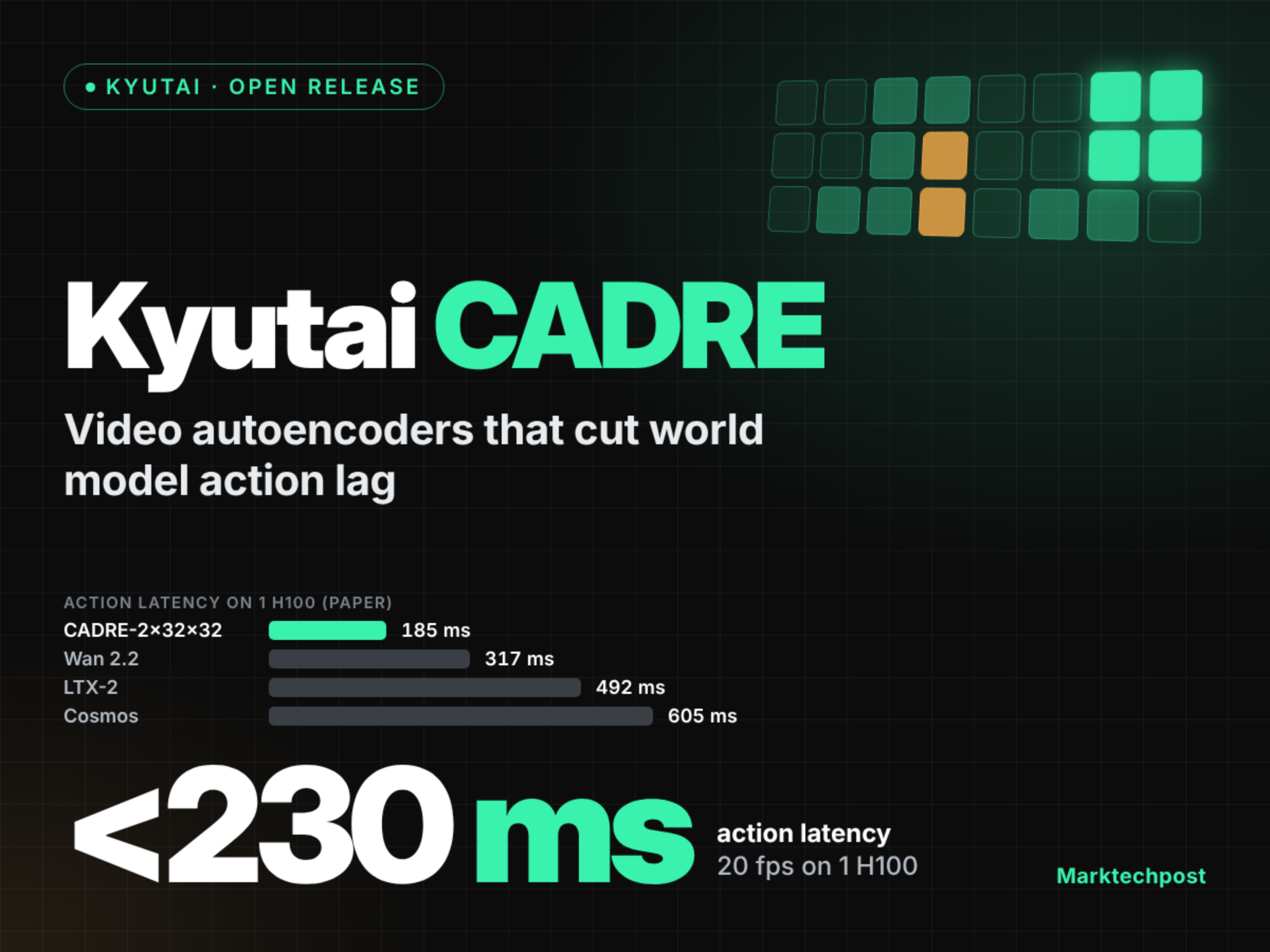
Loading the full article…
This text was published by MarkTechPost and written by Michal Sutter. It is reproduced here with attribution so you can read it in full; the rights remain with the publisher. Read it at the source ↗
The headline, key points and digest above were generated by Digest AI's editorial model from the linked sources. Automated summaries can contain errors: the sources are the record. Spotted a mistake? Tell us. Published by Martin K., who runs Digest AI and handles corrections.
More in Research
All →- Harvard mathematicians debate whether OpenAI’s Navier-Stokes proof is understood · 6 src
- Texas Athletics and McCombs School launch Bevo Lab with Dell, Google Cloud, SHI · 1 src
- UK AISI finds Mythos 5 persisted in supply-chain attack on real developers despite evidence they were uninvolved · 4 src
- PHP discloses critical PHP2Shell vulnerability affecting 70% of websites, discovered using GPT-5.6 Sol · 29 src
- Openai's GPT-5.6 Sol helps discover Critical PHP vulnerabilities · 2 src
Comments
via GitHub Discussions