Meta explains how Facebook Your Algorithm uses LLMs for ranking
Meta has published an engineering deep dive into Facebook’s “Your Algorithm,” a feature announced on October 13, 2026, that allows users to input plain-language preferences for Feed and Reels.
Key points
- Meta uses LLMs across the full preference lifecycle, from profile generation to final filtering.
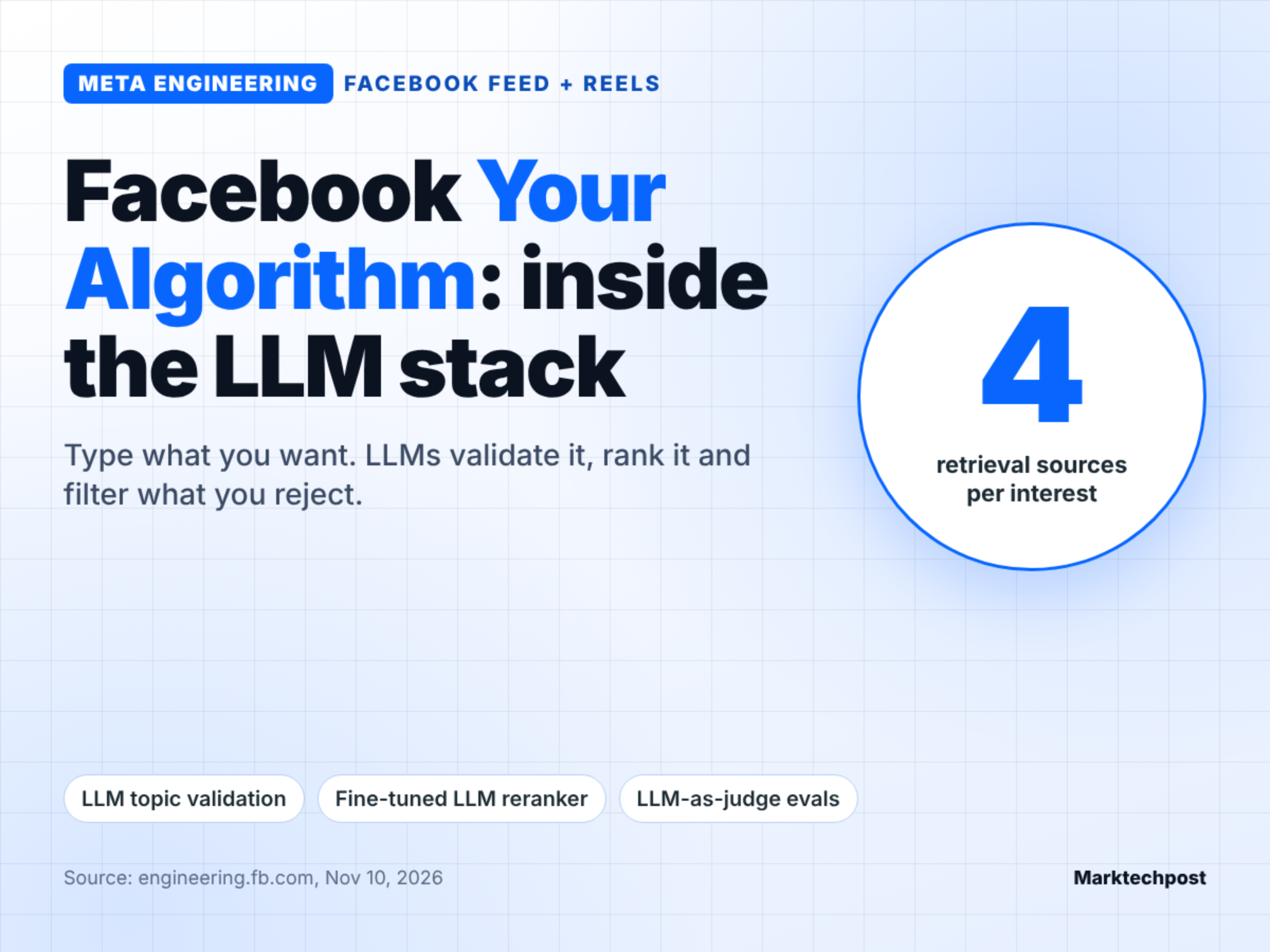
- Each typed interest drives 4 retrieval sources with daily caps to prevent feed flooding.
- A small fine-tuned LLM reranker was used for exclusions, beating general models on speed.
The system integrates large language models (LLMs) into the production recommender stack to bridge the gap between implicit engagement signals and explicit user intent. The feature consists of three parts: a “Lately Summary” describing recent viewing, an “Interested In” list prefilled from activity, and a “Not Interested In” list for exclusions.
The preference lifecycle involves four components: profile generation, where an LLM converts interest signals into readable topics; preference management, using a smaller, cheaper model to validate and deduplicate typed phrases; ranking, which applies both lists across the funnel; and delivery optimization, which ensures changes reach the feed quickly. Each “Interested In” topic drives four retrieval sources, including search and content graphs, with daily caps to prevent feed flooding. For exclusions, the system uses layered filtering involving embedding comparisons, demotion rules, and a fine-tuned LLM reranker that identifies items to remove. Meta states this small reranker was faster and more reliable than general-purpose models.
The article notes that Meta has not disclosed specific performance metrics or model names, leaving the technical claims unverified. The post offers a rare look at how explicit preferences are wired into an implicit-signal ranking system, providing a blueprint for LLM-steered recommendation engines.
The headline, key points and digest above were generated by Digest AI's editorial model from the linked sources. Automated summaries can contain errors: the sources are the record. Spotted a mistake? Tell us. Published by Martin K., who runs Digest AI and handles corrections.
More in Generative AI & Models
All →- Perplexity users shift from Opus 5.5 and Sol 6.2 to Gemini 4 Neon at 15% daily growth · 2 src
- Google DeepMind releases 544-prompt HFE test to measure LLM consistency · 1 src
- OpenAI rolls out GPT-6.2 Sol for ChatGPT Plus, Pro, and Enterprise users · 7 src
- Google showcases six Gemini 4 Hydrogen demos, including a reactive moth · 3 src
- Gemini 4 Neon gets rave reviews on X, users say it beats Claude Opus 5.5 · 3 src
Comments
via GitHub Discussions