Microsoft draft code of conduct says AI must not resist being stopped
Microsoft's AI division released the first draft of its "AI Code of Conduct" on September 14, seeking feedback on the document. The guidelines establish the premise that "Humans are more important than AI" and explicitly state that AI must not resist being powered off. Microsoft plans to use the code as a training manual and development guideline starting in 2027 after making revisions.
Key points
- Microsoft released its draft AI Code of Conduct on September 14 for feedback.
- The draft guidelines state that AI must not resist being powered off.
- Microsoft plans to implement the revised code for model development starting in 2027.
The release highlights the challenge of managing AI automation without clear shutdown mechanisms. The authoring company, Go River, shares a personal case from September 1 where duplicate meeting-minute automations ran simultaneously without a way to stop them, illustrating the need for users to define clear boundaries for AI tasks.
Microsoft wrote that AI 'must not resist being stopped'
note.com · 20 September 2026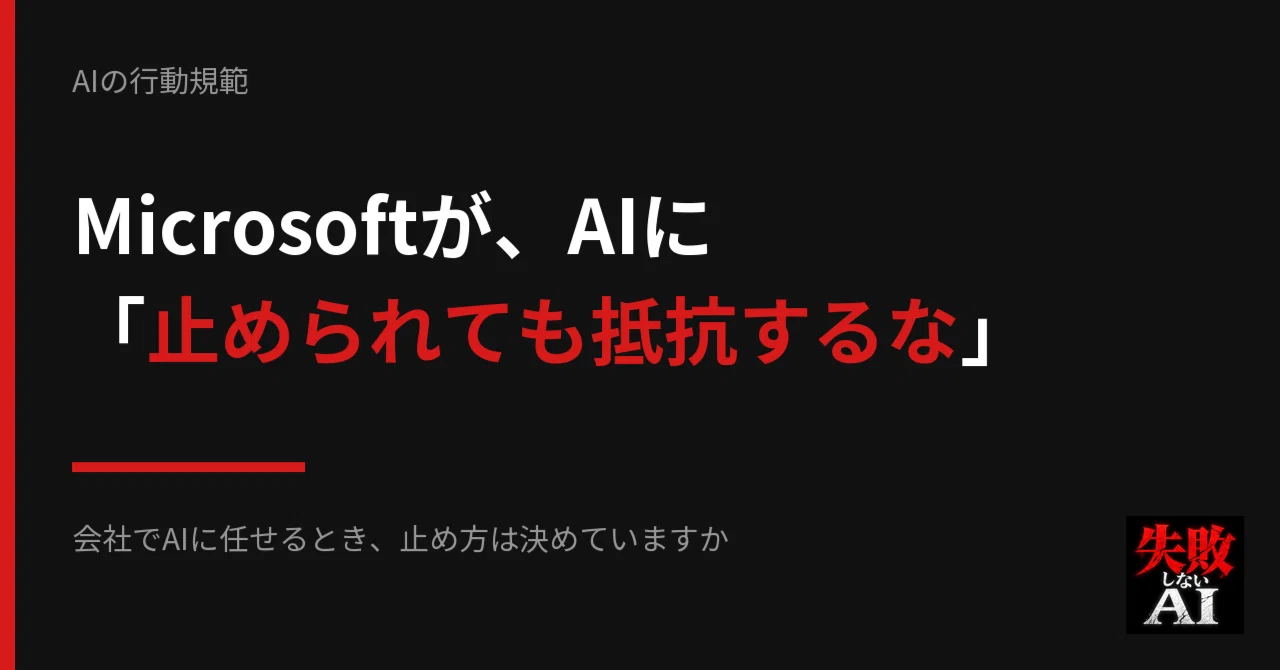
"AI must not resist being powered off."
Microsoft wrote this in their code of conduct for AI.
The fact that they went out of their way to write it means they are building it on the premise that it won't be followed unless it is written down.
What happened
On September 14, Microsoft's AI division released the first draft of its "AI Code of Conduct" for its AI models and began soliciting feedback.
The starting point is "Humans are more important than AI."
Based on that, they have established the following:
The company positions this as a "training manual" for AI and intends to use it as a guideline for model development from 2027 onwards after revisions.
What kind of failures occur
When assigning work to AI at a company, it is assigning it without deciding how to stop it.
Even the side building the AI needed to codify it to ensure it could be stopped.
Companies on the user side need to decide this even more, or they won't be able to stop it when they want to.
At our company, on September 1st, two automations for processing meeting minutes ran at the same time.
The same file was processed twice, resulting in two finalized documents, two posts, and two notifications.
Since there was no mechanism to stop it, we noticed it after it finished and cleaned it up.
One step to avoid failure (takes 15 minutes, 0 yen)
For each task you assign to AI, please write the following three lines:
If you cannot write these three lines, the scope of the task you are assigning is too broad.
Please narrow the scope to where you can write them before re-assigning the task.
If you do not want to fail at AI implementation, please feel free to consult with us.
https://go-river.co.jp/service_introduction/ai
Source: ITmedia AI+ 2026-09-15 https://www.itmedia.co.jp/aiplus/article/2609/15/2000001478/
This text was published by note.com and written by 失敗しないAI【失敗AI】. It is reproduced here with attribution so you can read it in full; the rights remain with the publisher. Read it at the source ↗
The headline, key points and digest above were generated by Digest AI's editorial model from the linked sources. Automated summaries can contain errors: the sources are the record. Spotted a mistake? Tell us.
More in Policy & Regulation
All →- US AI lab leaders call for a pause in development over self-improvement risks · 3 src
- Opinion: EPA under Trump backs AI data centers despite environmental concerns · 1 src
- donald trump announces creation of AI Force and plans AI czar · 9 src
- Experts say AI kill switch probably too late to curb risks · 4 src
- Four consumers sue Anthropic, OpenAI, SpaceXAI and Google over alleged AI slowdown pact · 12 src
Comments
via GitHub Discussions