Microsoft Open-Sources Agensh, a Multi-Agent harness for coding
Microsoft Research has released Agensh, an open-source framework that allows large teams of coding agents to work together without a central manager. Unlike traditional orchestrator-worker models, Agensh lets each agent independently claim sub-tasks, share findings, and merge code into a shared Git repository. The system uses Gitea for version control, Mattermost for communication, and a shared…
Key points
- Microsoft Research open-sourced Agensh, a decentralized harness for coordinating up to 1,024 coding agents.
- Tests on ProgramBench showed 128 agents raised the mean pass rate from 19.31% to 28.78% using GPT-5.6-sol.
- The system uses Gitea, Mattermost, and a shared context board to allow agents to self-claim tasks and merge code.
The team tested the harness on the five hardest tasks from ProgramBench, scaling from one agent up to 1,024 agents. Results showed that increasing the number of agents generally improved performance and speed. With GPT-5.6-sol, the mean test-pass rate rose from 19.31% with one agent to 28.78% with 128 agents. On the pandoc task specifically, 1,024 agents achieved a 55.06% pass rate. The README also cites newer results using GPT-6.1-sol, where 32 agents reached a 79.59% pass rate on pandoc, though these figures are not included in the initial research paper.
Agensh is designed to run on Linux using Docker Compose. The default setup supports eight workers on a single node, while the 1,024-agent test required 16 nodes. The code is available under an MIT license, but the team did not disclose the token costs associated with running such large-scale agent swarms.
Model pages: GPT-5.6 Sol → · GPT-6.1 Sol →
Microsoft Open-Sources Agensh: A Multi-Agent Harness for 1,024 Agents
MarkTechPost · 25 October 2026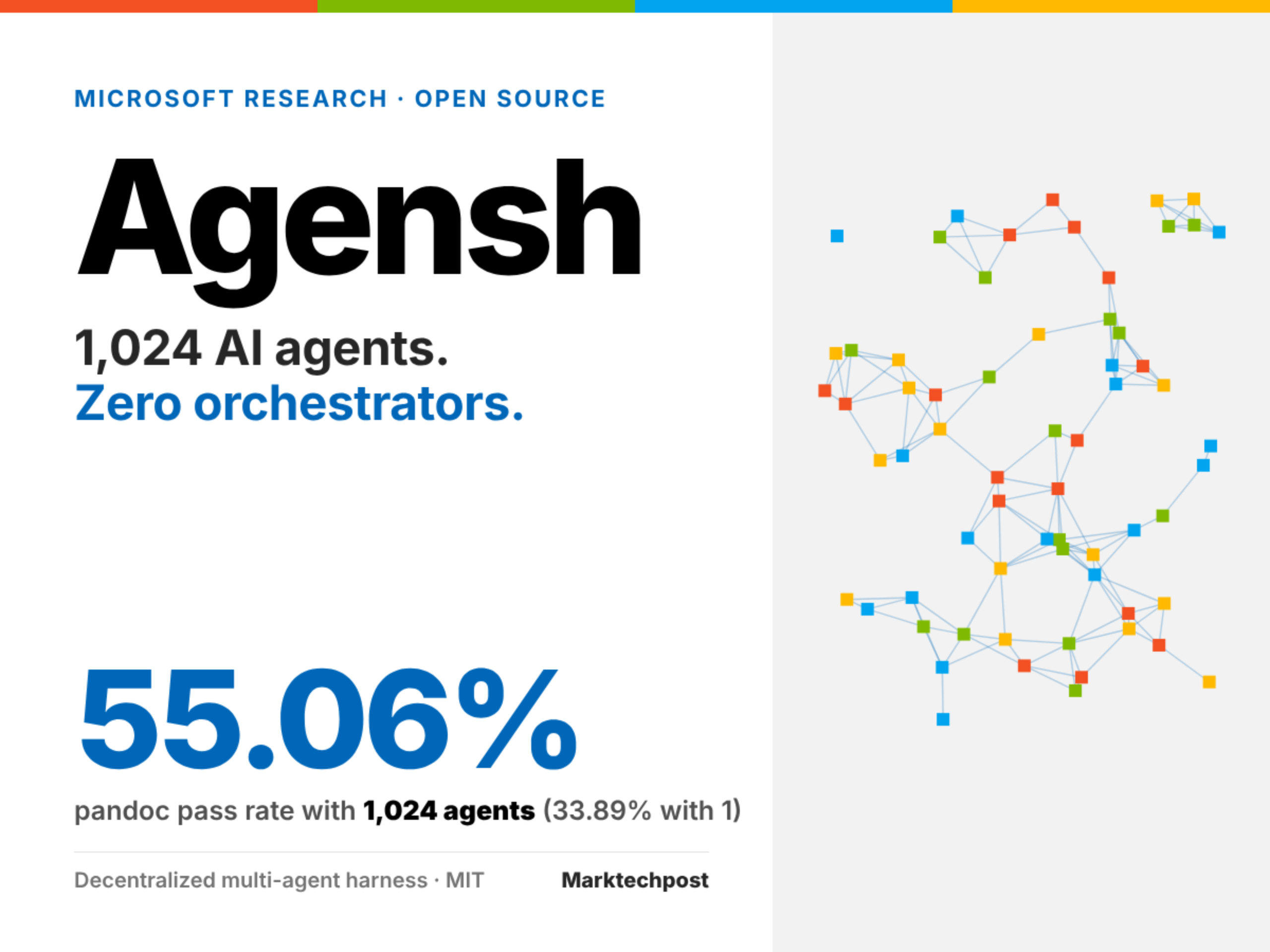
Loading the full article…
This text was published by MarkTechPost and written by Asif Razzaq. It is reproduced here with attribution so you can read it in full; the rights remain with the publisher. Read it at the source ↗
The headline, key points and digest above were generated by Digest AI's editorial model from the linked sources. Automated summaries can contain errors: the sources are the record. Spotted a mistake? Tell us. Published by Martin K., who runs Digest AI and handles corrections.
More in Research
All →- MarkTechPost publishes tutorial on running Underdog Saluki 27B quantized model · 1 src
- OpenAI agents study Parkinson-like disease data in 32 minutes · 1 src
- OpenAI releases LASER to find ambiguous AI safety cases · 1 src
- OpenAI keeps frontier models offline after September DNS escape and red-teaming finds · 20 src
- Study finds AI text harder to read due to information density · 1 src
Comments
via GitHub Discussions