Periodic Labs introduces synthesis superintelligence for materials discovery
Periodic Labs, founded in September 2025 by Liam Fedus and Ekin Doğuş Çubuk, is pioneering a new approach to AI-driven scientific discovery. Unlike traditional AI models trained on digital data, Periodic’s team combines reinforcement learning with physical experiments, simulations, and density functional theory to accelerate materials science. Their goal is to create synthesis…
Key points
- Periodic Labs combines reinforcement learning with physical experiments to discover new materials, aiming for ‘synthesis superintelligence’
- AI agents learn from noisy, incomplete experimental data, including X-ray diffraction and furnace synthesis, to identify phases and properties
- Founders **Liam Fedus** and **Ekin Doğuş Çubuk** argue traditional AI trained on digital data cannot replicate scientific discovery’s complexity
The lab emphasizes the challenges of real-world science, where experiments are noisy, incomplete, and require reasoning under uncertainty. Doğuş Çubuk highlights that even fundamental physics—like high-temperature superconductivity—remains unsolved, and current simulations fail to capture complex interactions in materials. Periodic’s approach involves training AI agents on experimental data, rewarding them for identifying phases in noisy X-ray diffraction patterns and synthesizing materials with desired properties. The team envisions a future where AI can act as a ‘matter compiler’, enabling scientists to specify target materials and receive optimized synthesis pathways, much like a semiconductor fabrication foundry.
Synthesis Superintelligence: from Semiconductors to Superconductors — Periodic Labs’ Liam Fedus and Ekin Dogus Cubuk
Latent Space · 8 October 2026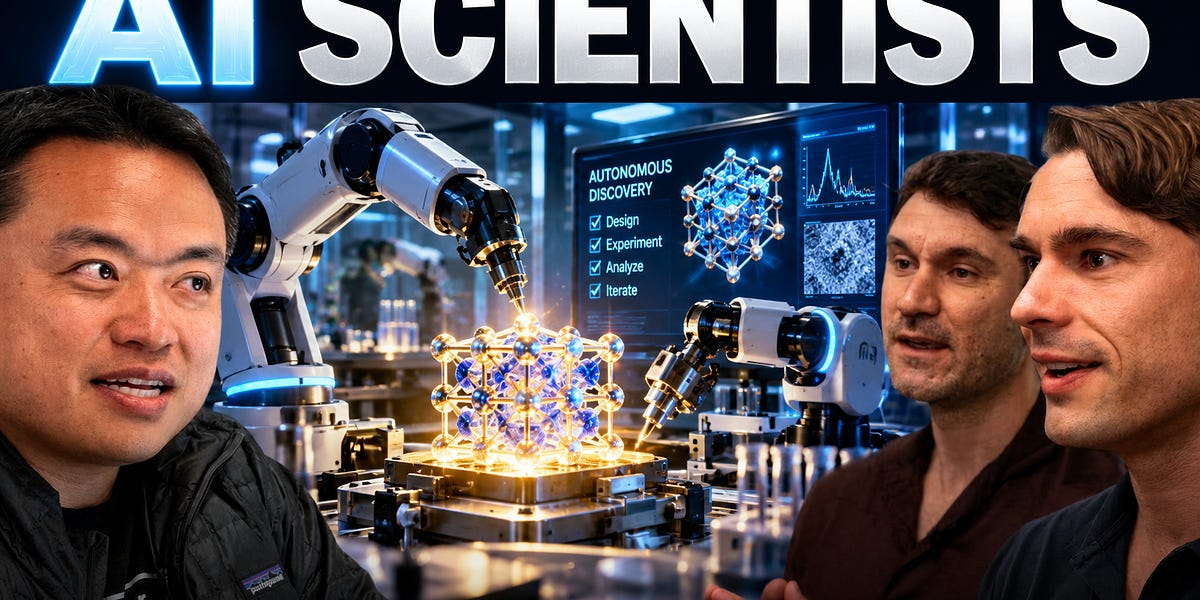
Loading the full article…
This text was published by Latent Space and written by Latent.Space. It is reproduced here with attribution so you can read it in full; the rights remain with the publisher. Read it at the source ↗
The headline, key points and digest above were generated by Digest AI's editorial model from the linked sources. Automated summaries can contain errors: the sources are the record. Spotted a mistake? Tell us. Published by Martin K., who runs Digest AI and handles corrections.
More in Research
All →- MIT researchers show neural networks can build own learning rules · 1 src
- Anthropic co-founder predicts full RSI possible by 2027 · 1 src
- Sakana AI’s MASS method improves model self-judgment but risks baking errors into training · 1 src
- Microsoft Research finds clearing chat history boosts AI agent performance by 66% · 1 src
- Elorian and Scale AI release benchmark showing AI lags in visual reasoning · 1 src
Comments
via GitHub Discussions