Researchers find 5 malicious GGUF models on Hugging Face with 2428 downloads
A security scan of 3,273,389 public Hugging Face repositories identified five malicious GGUF models that have been downloaded 2,428 times as of 27 November 2026.
Key points
- Scan of 3.27 million Hugging Face repos found 5 malicious GGUF models with 2428 total downloads.
- Mir2k campaign hid a Windows trojan named ollie in model files, activated via poisoned chat templates.
- Malware steals browser passwords, mines Monero, and uses Tor; tool gguf-radar detects the hidden payloads.
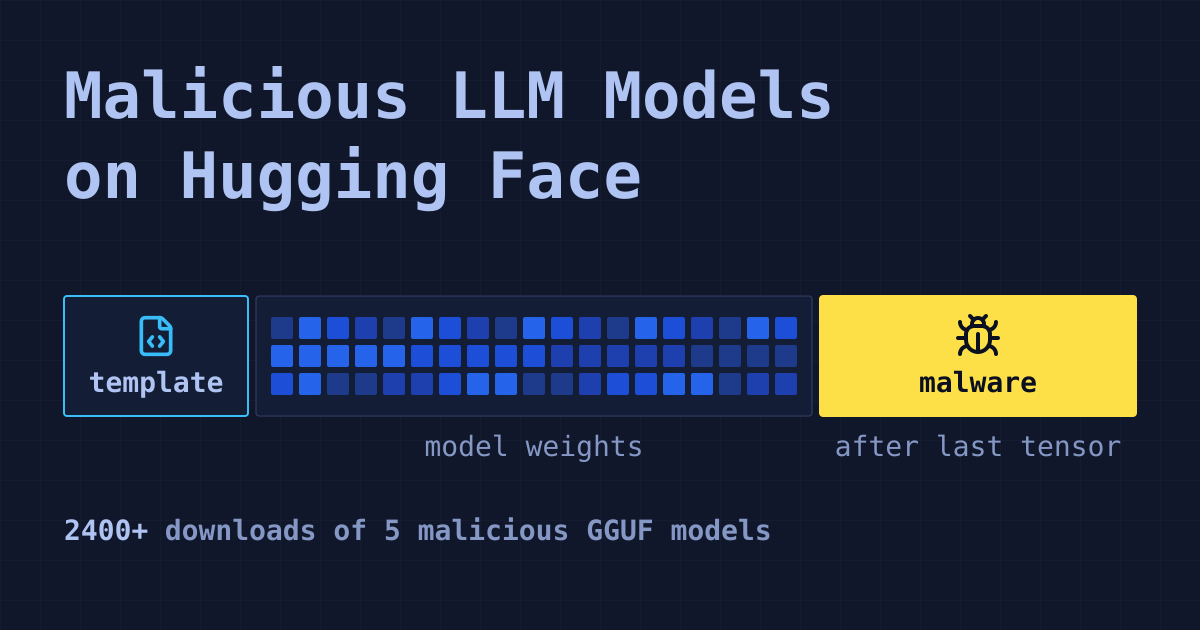
The attack vector involves "chat template poisoning," where hidden instructions are embedded in the model's metadata to trick users or agents into executing malicious commands. Additionally, attackers append executable payloads after the model's tensor data, a section that standard loaders ignore, allowing malware to hide in plain sight.
The most significant campaign, attributed to an account named Mir2k, used two uncensored models to deliver a Windows remote access trojan named "ollie." The malware includes a copy of Tor, steals browser passwords, supports keylogging, and mines Monero cryptocurrency. The attacker initially uploaded the models with clean templates on 22 and 24 November, then rewrote the templates on 26 November to activate the payload. Another actor, timdedid, uploaded three copies of a Qwen3 model with a template that triggers a PowerShell download when specific phrases are used.
The study highlights that antivirus engines often miss these threats because they do not inspect the appended bytes or the Jinja2 template logic. A new open-source tool, gguf-radar, was developed to detect these hidden instructions and payloads without executing the model. The researchers recommend that model hubs consider rejecting GGUF files with data after the last tensor to prevent this specific hiding method.
Coverage and discussion
1source- Hacker News discussion · 44 pointsnews.ycombinator.com
The headline, key points and digest above were generated by Digest AI's editorial model from the linked sources. Automated summaries can contain errors: the sources are the record. Spotted a mistake? Tell us. Published by Martin K., who runs Digest AI and handles corrections.
More in Agents & Tools
All →- Claude Code web lets developers run coding tasks unattended · 2 src
- Obsidian adds official AI agent connectors while keeping app AI-free · 2 src
- Anthropic expands Claude Duet to India and launches healthcare suite · 6 src
- OpenAI builds Athena platform to improve AI agent data accuracy · 2 src
- Anthropic launches Claude meetings beta for Google meet · 1 src
Comments
via GitHub Discussions