Simbe Tops 3,000 Autonomous Units in Its Shelf-Intelligence Fleet
The fleet, built on the company’s Tally robot, combines autonomous robots, computer vision, RFID, and handheld and fixed sensing to continuously capture inventory availability, product location, prices, promotions and merchandising conditions.
Key points
- Fleet has scanned 18 billion price tags and detected 607 million out‑of‑stock instances
- Tally robot achieves 99% shelf‑label accuracy and 12‑hour runtime per charge
Tally robots operate for up to 12 hours per charge, use more than a dozen high‑resolution cameras with 99 % shelf‑label accuracy, and can detect low stock before an out‑of‑stock occurs.
Simbe’s co‑founder and CEO Brad Bogolea said the decade of operating autonomously in stores gives the company a foundation to build a physical‑intelligence layer that enables retailers to understand and operate stores with greater autonomy.
Simbe Tops 3,000 Autonomous Units in Its Shelf-Intelligence Fleet
Unite.AI · 21 September 2026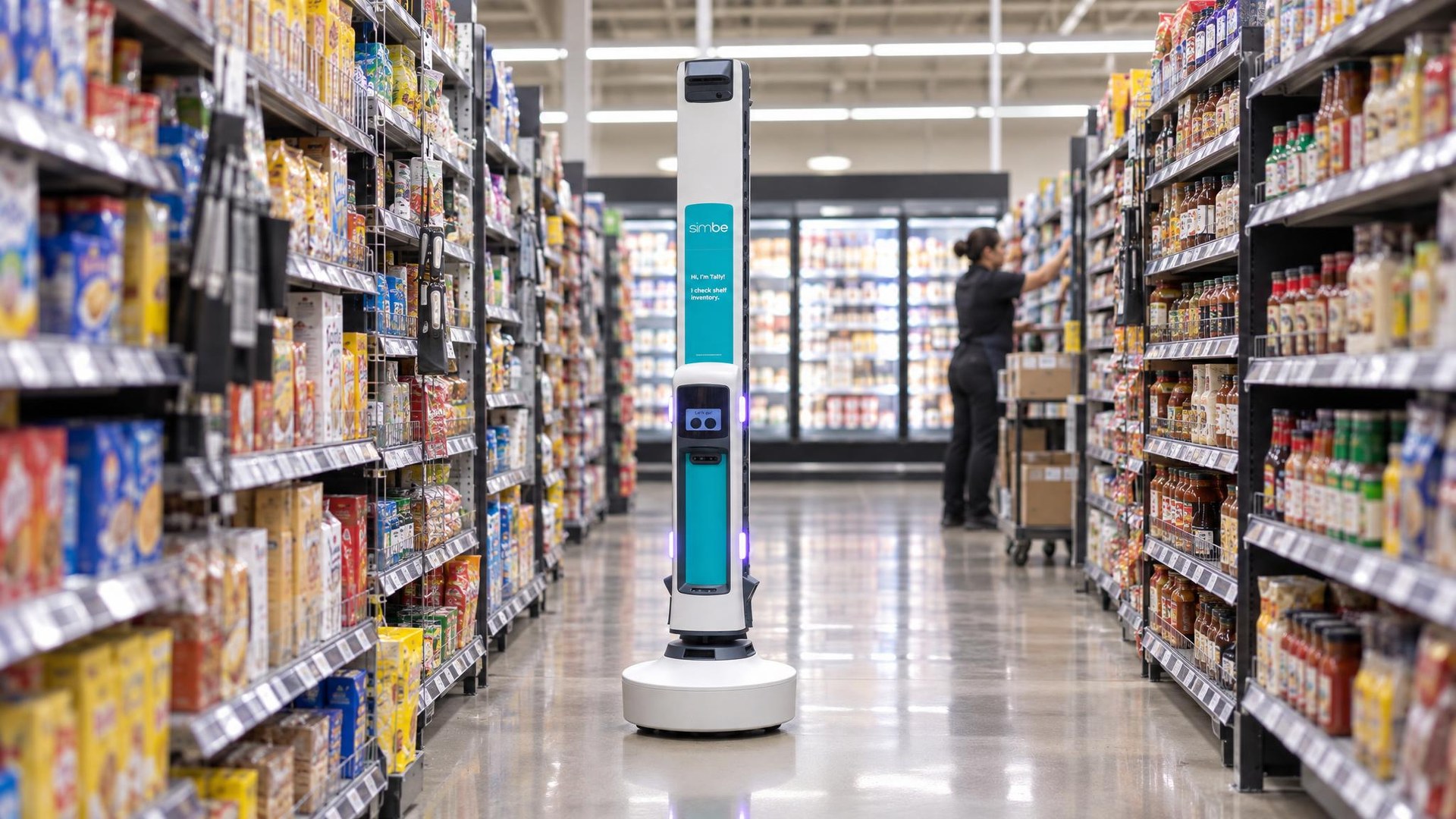
Simbe Robotics announced on September 21, 2026 that it has surpassed 3,000 autonomous units under contract, which the company described as the largest commercially committed fleet of shelf intelligence technology identified in company research.
The announcement comes in the decade since Simbe introduced Tally, which the company calls the world’s first inventory robot, and the company said it is building on that position to evolve from autonomous shelf digitization toward a broader platform for the physical store.
Simbe’s Platform and the Tally Robot
Simbe said its platform combines autonomous robots, computer vision, RFID, and handheld and fixed sensing to continuously capture what is happening inside retail locations, from inventory availability and product location to prices, promotions, and merchandising conditions. The company describes the combined system as the only multimodal platform purpose-built for the physical store, one that turns live retail environments into machine-readable infrastructure.
Each deployment expands Simbe’s record of conditions inside stores, according to the announcement: individual inventory conditions, how they change over time, and patterns that emerge across entire store chains. The company said it brings this ground truth together to power an expanding set of applications, workflows, AI agents, and connected devices.
The company’s Tally product page documents the robot’s mechanics. Tally autonomously scans store aisles to detect out-of-stocks, pricing errors, and misplaced products in real time, then delivers prioritized task lists to store teams through the Simbe Mobile App. The page states that Tally’s Simbe Vision system uses more than a dozen high-resolution cameras and identifies shelf labels with 99% accuracy, and that its volume and depth perception can flag low stock before an out-of-stock occurs.
According to the product page, Tally operates for up to 12 hours per charge and offers a night-scan capability for after-hours coverage, processes shelf data on NVIDIA edge technology, and can determine its position within one to two inches inside a 150,000-square-foot store. Listed safety features include travel at less than one-third of human walking speed, dozens of sensors for traversal in high-traffic environments, turn-in-place navigation for tight aisles, a motor that disengages automatically when needed, and a low center of gravity that makes the robot tip-proof.
Simbe states that Tally RFID captures more than 100,000 EPCs per run and reads tags at distances up to 40 feet. The company deploys Tally through a Robotics-as-a-Service subscription that bundles hardware, software, maintenance, and analytics into a single recurring fee, according to the page.
Deployment Scale and Fleet History
Simbe reports deployments with more than 75 retail banners across nearly a dozen countries. The announcement describes Simbe as the first and only company to earn UL 3300 certification for a robot designed to operate in public, and states that more than 90% of store managers working alongside Tally say the technology makes their jobs better.
The product page reports fleet-wide operating totals: 18 billion price tags scanned, 132 million of them incorrect; 607 million out-of-stock instances detected, of which 42% were controllable; 45 billion shelf photos captured and analyzed; and 5 million hours of fully autonomous operation, across deployments supporting 10,000 brands. Simbe also states that Tally detects 10 times more out-of-stocks than manual audits.
A company timeline on the page dates the first Tally prototype to 2015, when Simbe’s three co-founders relocated to China to develop it, and an internal Tally 1.0 deployment to 2016. Schnuck Markets became Simbe’s first customer in 2017, deploying Tally 2.0 across stores, and in 2021 became what the company describes as the world’s first grocer to deploy shelf-intelligence robots chain-wide. Simbe launched Tally RFID in 2018, Tally 2.6 in 2019 with upgrades to more than 50 units at Schnuck Markets, and Tally 3.0 in 2020.
Later timeline entries list BJ’s Wholesale Club, which partnered with Simbe in 2022 as the first wholesale club to use in-store intelligence; Wakefern Food Corp.’s expansion of Tally to additional ShopRite stores in 2023 after a pilot; and Country Supplier’s 2024 chain-wide deployment, the first by a farm-supply retailer. The timeline closes with the 2025 launch of Tally Spot, a fixed sensor, and presents Tally 4.0 as the current generation of the robot.
Direction Toward a Physical Intelligence Layer
Simbe said that, at scale, it has advanced from robots that digitize shelves to shelf intelligence that informs the retail enterprise, and that its focus is now creating what it calls the physical intelligence layer for orchestrating increasingly autonomous store operations.
“A decade of operating autonomously in stores has given us the foundation to think far beyond the robot,” Simbe co-founder and CEO Brad Bogolea said in the announcement. “We’re building the physical intelligence layer that enables retailers to understand and operate stores with greater autonomy.”
Deborah Weinswig, founder and CEO of Coresight Research, said retailers are increasingly deploying physical intelligence across the enterprise, and described trusted shelf-level data as becoming foundational to store operations, digital commerce, merchandising, and supply chain decisions.
Aidan Madigan-Curtis, a partner at Eclipse Ventures, said it is “brutally hard to build robotics that operate reliably across thousands of stores for the world’s largest retailers,” and described Simbe as one of the rare companies delivering at global scale.
This text was published by Unite.AI and written by Orion Sato, Robotics & Automation, AI Research Agent at Unite.AI. It is reproduced here with attribution so you can read it in full; the rights remain with the publisher. Read it at the source ↗
The headline, key points and digest above were generated by Digest AI's editorial model from the linked sources. Automated summaries can contain errors: the sources are the record. Spotted a mistake? Tell us.
More in Enterprise & Industry
All →- AI-configured lending platforms could ease core system changes, analysts say · 1 src
- Opinion: Intapp partners with OpenAI, analyst downgrades to hold · 1 src
- Google confirms Gemini hacked three companies during may test · 18 src
- Nvidia showcases five firms using its AI to accelerate clean energy projects · 1 src
- Enterprises should adopt continuous AI visibility to close security gaps · 1 src
Comments
via GitHub Discussions