Stanford physicist Venkatesa Chandrasekaran proposes gravity theory using GPT-6 Astra
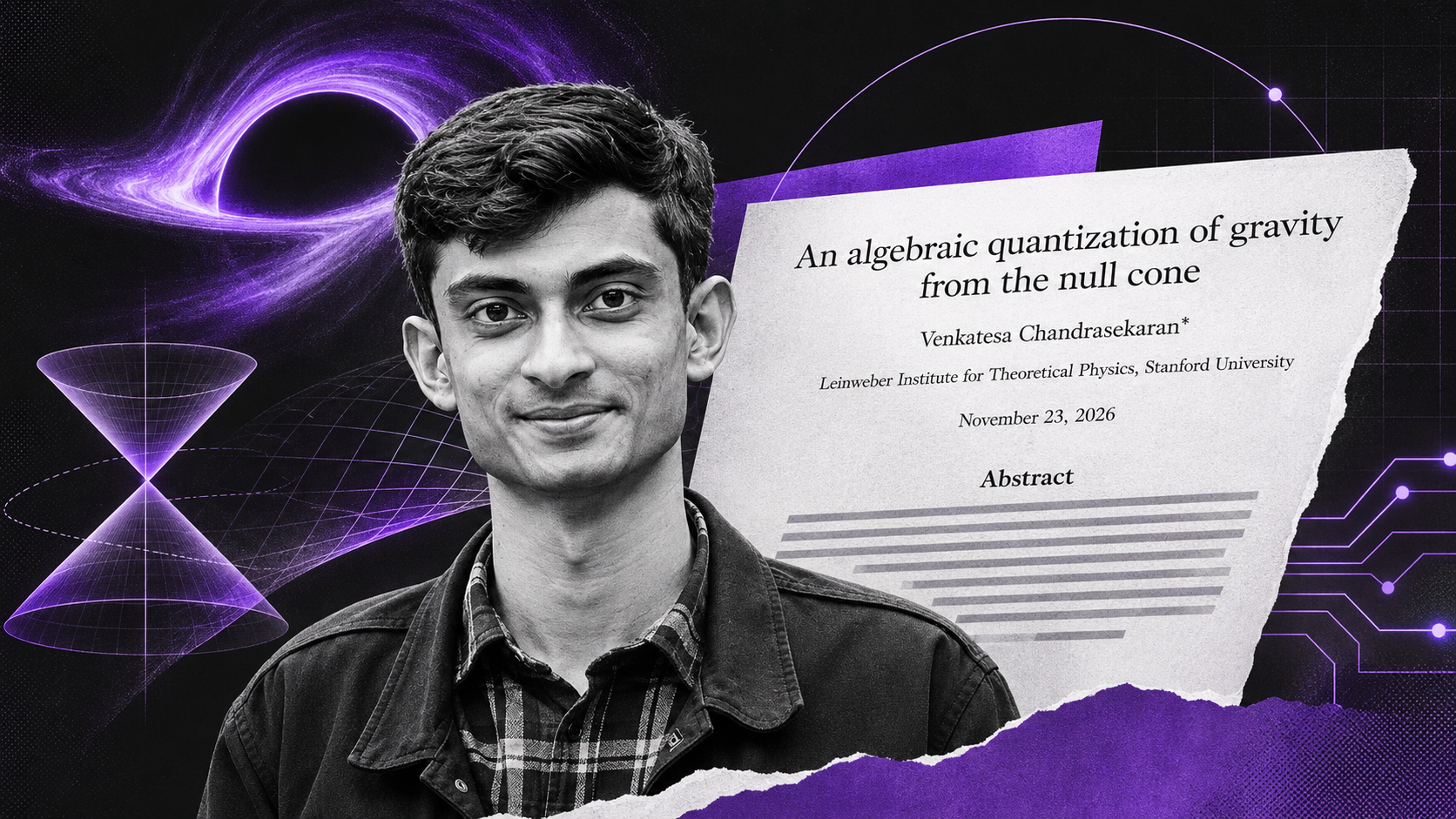
Stanford physicist Venkatesa Chandrasekaran released an 83‑page preprint that outlines a quantum‑gravity framework. The paper says the calculations and proofs were developed with the help of OpenAI’s GPT‑6 Astra over roughly 400 million tokens.
Key points
- Stanford physicist Venkatesa Chandrasekaran released an 83‑page preprint proposing a gravity theory developed with GPT‑6 Astra over ~400 M tokens.
- The paper claims to avoid infinities and matches known black‑hole results, but only addresses empty space and excludes matter.
- Physicists Jonathan Oppenheim and Peter Woit criticized the work, while Sam Altman praised Chandrasekaran’s effort.
The approach describes gravity in empty spacetime using light‑path trajectories, claims to avoid the infinities that plague traditional quantum‑gravity attempts, and reproduces known black‑hole and general‑relativity results, though it does not yet incorporate matter.
Sam Altman praised Chandrasekaran’s confidence and courage, while several physicists expressed skepticism. Jonathan Oppenheim of UCL noted that the AI flagged more than a dozen issues, and Columbia’s Peter Woit dismissed the work as a publicity stunt. The paper remains unreviewed, so its claims have not been validated by the broader community. If the method proves sound, it could give researchers a new computational tool for probing regimes where Einstein’s gravity and quantum mechanics intersect, such as black‑hole interiors and the early universe.
Model page: GPT-6 Astra →
The headline, key points and digest above were generated by Digest AI's editorial model from the linked sources. Automated summaries can contain errors: the sources are the record. Spotted a mistake? Tell us. Published by Martin K., who runs Digest AI and handles corrections.
More in Research
All →- Anthropic mathematician claims Claude proves Riemann Hypothesis with Lean code · 45 src
- OpenAI Finds Exoplanet Candidates: Non-specialists team up with AI · 2 src
- Erdil and Kokotajlo debate odds of intelligence explosion before 2029 · 1 src
- Former OpenAI researcher says AI‑generated Riemann proof matters less than the capability · 1 src
- Claude predicts XRP could drop to 74.5 cents if Bitcoin falls to $50,000 · 1 src
Comments
via GitHub Discussions