Nvidia and Palantir Signal Continued AI Build-Out
Two prominent players in the AI landscape, Nvidia and Palantir, have signaled that their growth is continuing unabated. Nvidia's latest earnings report showed a significant increase in revenue to $96.2 billion, driven by strong data center sales of $89 billion. The company attributes this growth to its ACIE group, which includes AI clouds, industrial customers, and enterprises. Palantir reported…
Key points
- Nvidia's revenue grew to $96.2 billion
- Palantir reported a 93% year-over-year revenue growth to $1.9 billion
- Micron Technology is benefiting from AI data center demand for HBM
The story so far
4 episodes →- Nvidia and Palantir Signal Continued AI Build-Outthis story
Nvidia and Palantir confirmed the AI build-out continues
fool.com · 10 September 2026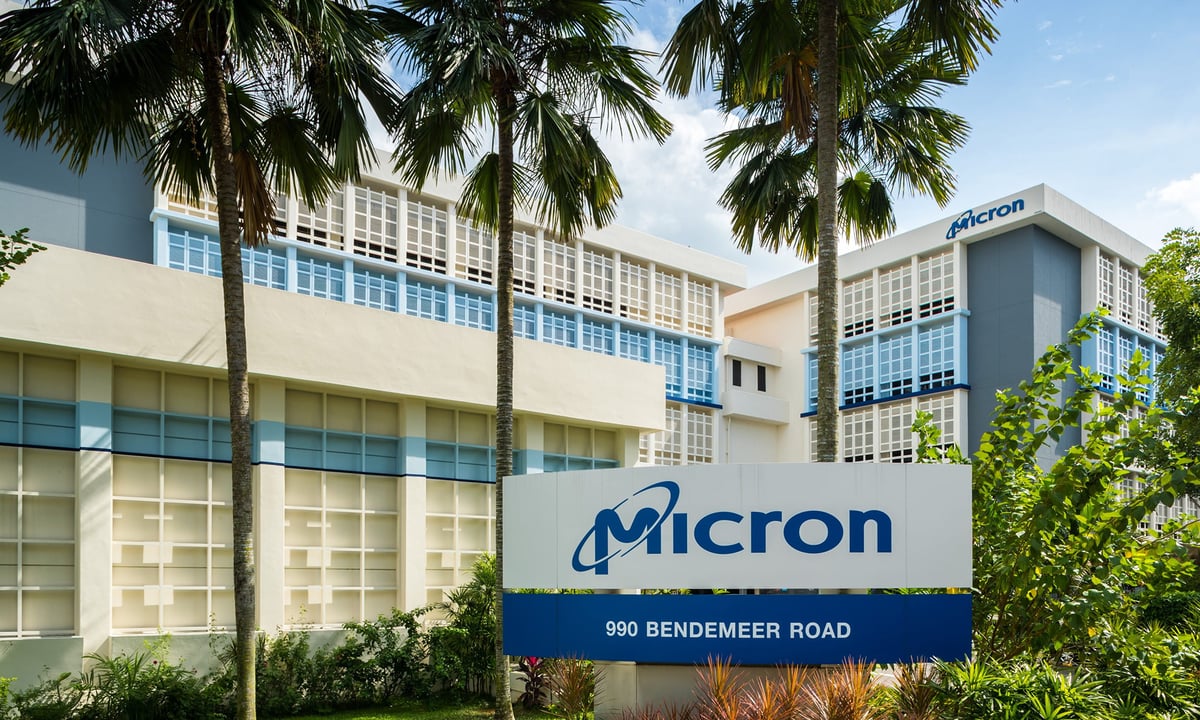
When it comes to artificial intelligence (AI), two names seem to get more airtime than their peers: Nvidia (NVDA -0.03%) and Palantir Technologies (PLTR +0.83%). Over the current earnings season, investors have already gotten thorough downloads on how Nvidia and Palantir are performing. Spoiler alert: They both look unstoppable.
However, the company I think sits at the tightest choke-point in the entire AI infrastructure build-out is Micron Technology (MU -0.22%). The memory shortage has become the bottleneck that tech sector CEOs are talking about out loud. While Micron won't report its results till the end of the month, Nvidia and Palantir have already signaled the cycle is running in its favor.
Nvidia and Palantir confirmed the AI build-out continues
Nvidia's latest earnings report was the kind of print that resets conversations. Total revenue was $96.2 billion, more than double what it took in during the year-ago quarter. Data center sales reached $89 billion, up 117% year over year. Naturally, hyperscalers still matter a lot to Nvidia's data center segment. Big tech customers comprised $48.7 billion of the company's data center sales. The faster-growing slice, however, was its "ACIE group" -- AI clouds, industrial customers, and enterprises. This market segment generated $40.3 billion in revenue, up 138% year over year and 25% from the prior quarter.
Palantir is achieving in software what Nvidia is in hardware. During the second quarter, its revenue surged 93% year over year to $1.9 billion. Sales from the U.S. commercial segment jumped 149% year over year to $764 million. Given this momentum, management raised full-year revenue guidance to a little over $8.2 billion, implying 82% growth.
Palantir's Artificial Intelligence Platform (AIP) is not a pilot project anymore. Fortune 500 companies are embedding Palantir's platforms -- Foundry, Gotham, and Apollo -- into their daily operations, and the company's bookings suggest its sales acceleration will continue.
These two reports were not isolated. Nvidia and Palantir are proving that both the hardware layer and the software layer of the AI revolution are still expanding at paces that most on Wall Street would have called unsustainable even just two years ago.
Upstream dollars are now flowing downstream
The growth displayed by Nvidia and Palantir is excellent news for Micron because the AI stack is vertical. You can't sell more data center GPUs or more enterprise software platforms without putting a lot more high bandwidth memory (HBM) into the equation. Nvidia itself has made this abundantly clear. Last quarter, the company boosted its supply and capacity commitments through its fiscal 2032 by $160 billion to a total of $279 billion, with management saying the bulk of those commitments are for memory purchases.
Hyperscalers and AI-cloud operators continue to place enormous orders for Nvidia's GPUs. Software companies like Palantir then sell platforms and services that make these GPUs useful within production environments. The subtle beneficiary here is Micron, because every extra new accelerator installed and every AI deployment needs incremental stacks of HBM.
Micron is one of only three companies that can deliver these key types of memory at scale. DRAM pricing has soared because AI data centers are gobbling up a huge portion of available production. This shows how upstream success does not stay upstream. Downstream in the AI value chain, it manifests as tighter supply and better pricing for component makers like Micron.
Key Data Points
The market could recalibrate its view of Micron on Sept. 30
Micron reports its fiscal 2026 fourth-quarter results after the closing bell on Sept. 30. The consensus estimates among Wall Street analysts are that it will report $50.8 billion in revenue and about $31.28 in earnings per share (EPS). The reason Micron could actually beat these forecasts is that pricing and product mix keep moving in its favor. Next-generation HBM4 is ramping up for the next wave of Nvidia systems, while conventional DRAM supply remains tight.
To me, Micron's valuation story is a curiosity. On a trailing-12-month basis, Micron stock may look expensive because its earnings explosion is still catching up to the stock price. On a forward price-to-earnings (P/E) basis, however, Micron is trading more like a cyclical industrial stock as opposed to a company positioned in the middle of a multiyear infrastructure boom.
Nvidia and Palantir are already priced like true AI winners -- deservedly so. On a forward earnings basis, Micron remains priced like a commoditized memory producer that investors expect to eventually repeat its familiar boom-and-bust cycle. Yet memory is now a scarce resource, and every GPU produced and every enterprise AI system deployed needs it to function. If Micron merely delivers what Wall Street expects and then confirms that demand remains robust, its valuation multiple has significant room to expand alongside its still-rising earnings. That is why, in this particular month, Micron looks like the most important AI infrastructure stock.
This text was published by fool.com and written by Adam Spatacco. It is reproduced here with attribution so you can read it in full; the rights remain with the publisher. Read it at the source ↗
Coverage and discussion
5sources- Michael Burry Just Said 7 Words Dismissing AI After Slowdown Fears: "There Is Nothing AI to Slow Down." Should Investors Trust His Nvidia and Palantir Shorts?Press · finance.yahoo.com ·
- Palantir and Nvidia Emerge as Key Players in Government AI ModernizationPress · finance.yahoo.com ·
- AI Extinction Fears Could Crush Nvidia’s $1.3 Trillion Growth Engine, but Don’t Panic Sell Just YetPress · finance.yahoo.com ·
- Palantir stock may win even if AI boom slows: why Wall Street sees 50% upsidePress · invezz.com ·
The headline, key points and digest above were generated by Digest AI's editorial model from the linked sources. Automated summaries can contain errors: the sources are the record. Spotted a mistake? Tell us.
More in Business & Funding
All →- OpenAI applies mitigation and monitors recovery after elevated API error rates · 1 src
- Nvidia CEO says company will double chip sales next year · 2 src
- Crusoe raises $3.9 billion Series F, valuing company at $30.9 billion · 1 src
- CleanSpark raises $2.2 B via junk bonds to fund Meta‑linked AI data center · 2 src
- OpenAI launches Sponsored Agents and AI ad tools in ChatGPT · 8 src
Comments
via GitHub Discussions