Opinion: AI adaptation, not adoption, is the real work ahead
Pam Boiros, a fractional CMO at Bridge Marketing Advisors and former marketing leader at Skillsoft and meQuilibrium, argues that most marketing teams have stopped at AI adoption and need to move toward AI adaptation. She defines adaptation as redesigning workflows so that humans and AI each play to their strengths, with managers coaching AI‑assisted work, setting guardrails, and measuring…
Key points
- Boiros says true AI adaptation means workflows redesign around human‑AI strengths, not just tool rollout.
- She identifies five building blocks for adaptation: skills, workflows, guardrails, measurement, and culture.
- Boiros’ MAICON session will give a playbook with examples from three years of marketer training.
Boiros outlines five building blocks for successful adaptation—skills, workflows, guardrails, measurement, and culture—and stresses that culture is often underestimated. She recommends giving marketers protected time to experiment, fostering collaborative learning, and celebrating both successes and failures. At MAICON 2026, her session will provide a practical playbook drawn from three years of training marketers, offering concrete steps to turn scattered AI experiments into repeatable, resilient processes.
Why AI Adaptation, Not Adoption, Is the Real Work Ahead
Marketing AI Institute · 21 September 2026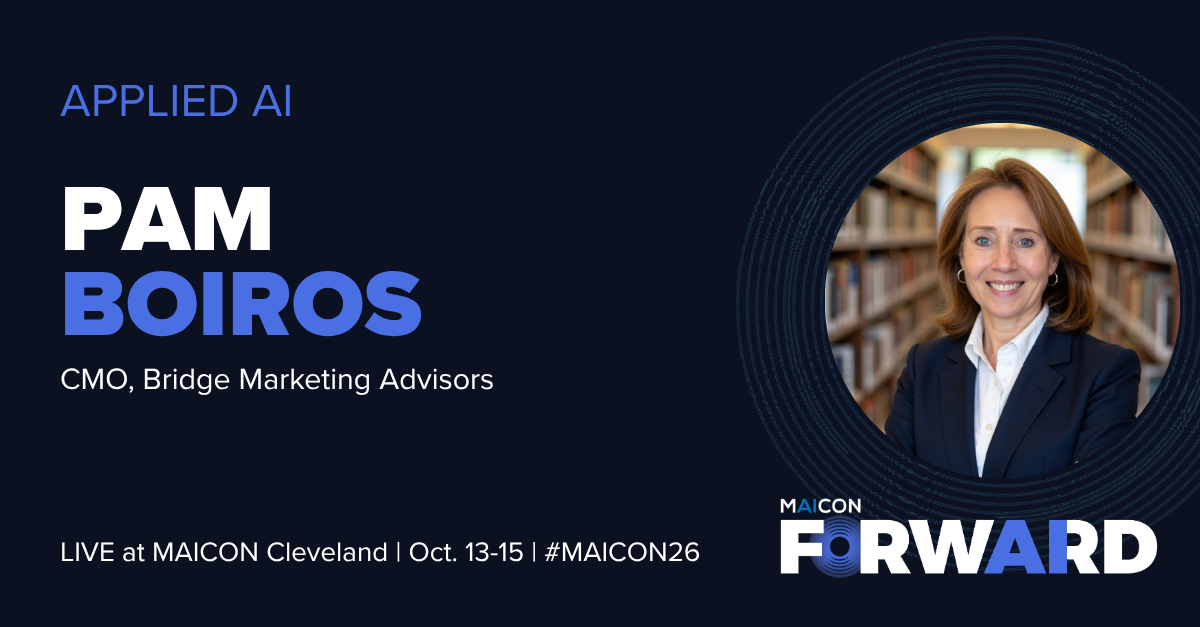
Most marketing teams have rolled out AI tools. Far fewer have changed how they work with them in their jobs.
The gap between adoption and adaptation is what Pam Boiros will address at MAICON 2026 in her session, "AI Adaptation: The People Side of Scale."
Boiros is a fractional Chief Marketing Officer at Bridge Marketing Advisors and an AI strategist who has led marketing organizations at companies including Skillsoft and meQuilibrium. She is also the co-founder of Women Applying AI, a global community focused on helping women build practical, hands-on AI skills.
Adaptation Is a Different Way of Working
For leaders who feel they've already done the hard part by rolling out AI tools, Boiros draws a sharp line between what's been accomplished and what still lies ahead.
"You know you've moved from AI adoption to AI adaptation when AI stops feeling like a separate initiative and starts changing how the work itself gets done," Boiros says.
Adoption is relatively easy to spot: people have access to tools, attend training, and individual use cases start to surface. Adaptation looks different. Teams begin redesigning workflows around what humans and AI each do best. Managers coach AI-assisted work and set expectations for quality. People have enough confidence to experiment, enough judgment to challenge the output, and enough clarity about guardrails that they aren't constantly wondering what's allowed.
The measurement changes too. Leaders start asking better questions: Are we producing better work? Are people spending more time on work that requires human judgment, creativity, and relationships? Have we created repeatable ways of working that can survive the next tool or model change?
Building Block Teams Can Underestimate
Boiros has identified five building blocks of AI adaptation:
- Skills
- Workflows
- Guardrails
- Measurement
- Culture
The one most teams underestimate, she says, is culture.
“Culture shows up in what people actually feel safe and empowered to do every day," Boiros says.
AI asks people to learn in new ways and try things they might not be good at yet. They might also have to admit when they don't know something and rethink parts of a job they've spent years mastering. In cultures that reward certainty and polished answers, people default to caution. Some avoid AI entirely. Others experiment quietly and keep what they learn to themselves.
The teams making the most progress do the opposite. They create environments where curiosity is valued, experimentation is expected, and sharing what didn't work is as useful as sharing what did. When leaders use AI themselves, talk openly about what they're learning, and give people room to experiment responsibly, they send a powerful signal, and AI starts becoming a team capability rather than an individual productivity hack.
Why Resistance Isn't What Leaders Think
After three years of training marketers and teams, Boiros says the most common source of resistance is fear, although it might not be obvious.
It often shows up as "I don't have time to learn another tool," or "I'm not sure this is relevant to my job," or "I tried AI once, and the result wasn't great." Underneath is uncertainty about role, career, and whether it's already too late to catch up.
"That's why I don't think the answer is simply more training," Boiros says. "What works better is creating space for people to learn without feeling like they're taking on a second job."
Her approach is to start with work people already need to do. Give them protected time to experiment. Make learning collaborative so peers can see how others are using AI and ask questions without feeling exposed. Small wins matter more than grand transformation plans. When someone uses AI to improve a real workflow or produce a better result, the conversation shifts from "Why do I have to use this?" to "Where else could this help me?"
What Boiros Will Explore at MAICON
This session is for leaders at all levels who need to drive AI adaptation, not just adoption, across a team. Boiros will unpack what has to shift after the pilot: building confidence and trust, turning scattered experimentation into repeatable workflows, reducing resistance without burning people out, and setting the processes and guardrails that make AI safer and easier to use.
What You'll Gain from Boiros' Session
Attendees will leave with a practical playbook they can use immediately, including:
- The five building blocks of AI adaptation — skills, workflows, guardrails, measurement, and culture — and how to apply each
- Real examples from three years of training marketers and teams
- Specific ways to reduce resistance without burning people out
- A framework for turning scattered experimentation into repeatable workflows that survive the next tool or model change
Join Us at MAICON 2026
Boiros joins an expert lineup focused on real-world AI strategy, implementation, and leadership.
Boiros will focus on what it really takes to adapt to AI: shifting not just tools, but how teams think, work, and make decisions. She brings a mix of curiosity, real-world experience, and just enough edge to spark honest conversation and meaningful takeaways.
Follow Boiros before MAICON 2026:
Join us at MAICON 2026 to hear Boiros and 50+ other AI and business leaders. Register today.
This text was published by Marketing AI Institute and written by Cathy McPhillips. It is reproduced here with attribution so you can read it in full; the rights remain with the publisher. Read it at the source ↗
The headline, key points and digest above were generated by Digest AI's editorial model from the linked sources. Automated summaries can contain errors: the sources are the record. Spotted a mistake? Tell us.
More in Marketing & Small Business
All →- OpenAI tests Sponsored Agents to let ChatGPT users chat with brand AIs · 2 src
- Opinion: marketers should produce fewer AI‑generated assets to avoid bottlenecks · 1 src
- Darren Shaw and Russ Jeffery outline how to make local pages AI‑ready · 1 src
- Opinion: transparent AI loading screens boost perceived value, studies show · 1 src
- Opinion: Using ChatGPT Work, plateau and video AI to streamline Blender production · 1 src
Comments
via GitHub Discussions