OpenAI tests Sponsored Agents to let ChatGPT users chat with brand AIs
OpenAI announced on September 16 that it has begun testing "Sponsored Agents" in the US. The system allows ChatGPT users to click on an ad and start a conversation with a dedicated AI agent sponsored by the advertiser. These ad conversations are clearly labeled and separated from ChatGPT's regular responses to maintain user trust.
What you can do with it
AI at Work →Allows advertisers to connect conversational AI agents to ChatGPT ads and manage campaigns via Shopify or HubSpot.
- Who for
- marketers
- Cost
- Cost not stated
- Effort
- needs a developer
Use it for
- Answering customer product questions
- Creating ad campaigns
- Tracking lead performance
Watch out The feature is currently in testing with a select group of US advertisers and is not yet globally available.
Key points from the news
- Sponsored Agents let users ask questions about products directly inside ChatGPT ad spaces.
- Conversations with brand agents are separated and labeled to distinguish them from standard ChatGPT responses.
- New integrations allow HubSpot and Shopify merchants to manage ChatGPT campaigns from their existing platforms.
Alongside the agents, OpenAI announced three other features for advertisers. Users can create and manage campaigns using natural language via an Ads Manager plugin, and access AI-powered copy and image suggestions. OpenAI also announced integrations with HubSpot and Shopify, marking its first CRM and e-commerce partnerships. The Shopify app is scheduled for international rollout starting September 23 in markets where ChatGPT Ads are available.
The story so far
2 episodes →- OpenAI tests Sponsored Agents to let ChatGPT users chat with brand AIsthis story
What are OpenAI's "Sponsored Agents"? Clicking on ChatGPT ads starts a conversation with a company's AI
note.com · 20 September 2026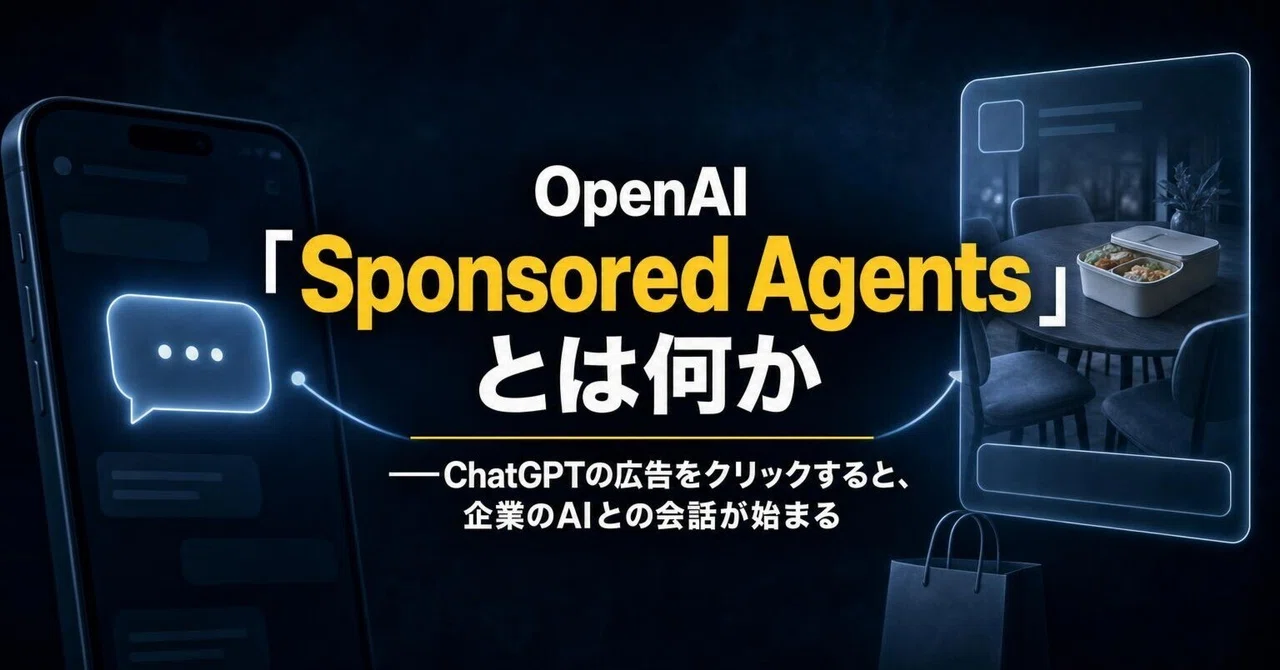
What are OpenAI's "Sponsored Agents"? Clicking on ChatGPT ads starts a conversation with a company's AI
For example, suppose you see an ad for a dining table on ChatGPT. You're interested, but you don't know if it will fit in your room, how many people can sit at it, or if it's easy to maintain. You can't tell just from the ad.
On September 16 (US time), OpenAI announced that it has begun testing "Sponsored Agents," a system that allows you to ask those questions right there in the ad space. When you click on an ad, you can start a conversation with a dedicated AI sponsored by the company.
In this article, I will organize what has changed, focusing on Sponsored Agents and including the simultaneously announced features for advertisers, as well as where the work of advertisers is shifting.
Four new features have been announced.
OpenAI's official announcement summarized the new features for ChatGPT ads. I will break them down into four new features.
The first is "Sponsored Agents." After clicking an ad, you can converse with a dedicated AI agent sponsored by the company.
The second is a feature that allows you to create ads within ChatGPT. You can create, update, and analyze campaigns simply by giving instructions in natural language to the "Ads Manager plugin."
The third is AI-powered production support within the ad management screen. The AI suggests ad copy and images based on the ad's destination page and purpose. This also includes automatic adjustment and translation of wording to match the context of the conversation.
The fourth is integration with HubSpot and Shopify. For OpenAI, these are its first CRM (customer relationship management) partner and first e-commerce partner.
Note that Sponsored Agents are currently being tested with a select group of advertisers in the US and are not yet available in Japan. However, they will likely come to Japan eventually.
ChatGPT ads themselves began testing in Japan in June, about four months after testing began in the US in February. In my estimation, Sponsored Agents will likely be available in Japan by the end of the year.
Clicking an ad lets you talk to a company's AI
The flow for Sponsored Agents is as follows: you see an ad, click it, and choose whether to start a conversation. Once you start, you can ask questions by conveying your specific requirements, and if you are satisfied, you proceed to the company's website.
The example OpenAI gave was a dining table. Will it fit in the room? How many people can sit at it? How do you maintain the surface? You can ask the company's AI these questions right in the ad space.
The important thing is that the user chooses whether or not to start the conversation. The conversation does not start just by looking at the ad.
With traditional banner ads, the standard was to move to the company's page upon clicking. If questions remained, you had to search for answers on that page. I believe Sponsored Agents is a mechanism to fill that gap after the click with dialogue.
Conversations are separated into a "separate frame"
OpenAI explains that conversations with Sponsored Agents are clearly labeled. They are distinguished from ChatGPT's own independent responses and are separated from the conversation the user started initially.
I believe this separation protects the trust that ChatGPT's regular responses are not influenced by specific advertisers. If the conversation were continuous, the reader would not be able to tell where neutral information ends and advertising begins.
On the other hand, there are things we don't know. Is the separation only a label on the screen, or is the conversation data itself blocked? This is not written in the announcement text.
Separating ChatGPT's independent answers from ad conversations. Whether this line is maintained will determine the credibility of this mechanism.
Best suited for purchases that involve questions
They are well-suited for products that generate specific questions, such as those regarding size, specifications, or maintenance. This applies to purchases that require time to consider, like furniture or home appliances.
Conversely, as organized in a previous article, Google and Meta are currently better at products that encourage impulse buying through visual impact, or awareness ads that aim for mass exposure. For high-priced services that require long inputs or sales meetings after clicking, interest is also more likely to cool off during the conversation.
Purchases that involve questions. The first step is to apply this condition to your own products.
▶︎ Read more: Products suitable and unsuitable for ChatGPT Ads—Organized from 200 days of results
The advertiser's job shifts from "creating" to "verifying"
AI is also entering the side of those placing ads. Advertisers can create campaigns within ChatGPT based on their websites or briefs (documents summarizing the purpose and conditions of the ad). They can also receive performance tracking and suggestions for next steps on the same screen.
The mechanism is designed so that advertisers choose whether to adopt ad copy and image suggestions after reviewing and editing them. Automatic adjustment and translation of wording are opt-in features that only work when the advertiser enables them.
The announcement does not state how campaigns created by plugins are verified before publication. However, the more suggestions the AI makes, the more there is to verify.
Even if creation time decreases, the judgment of "is it okay to publish" remains. The quality of that judgment will determine the results.
▶︎ Read more: AI creates proposals, humans approve them—Anthropic's commerce blueprint
What HubSpot and Shopify change is the "location"
What Ads Manager changes is the content of ad creation. What the integration with HubSpot and Shopify changes is the place where that work is performed.
In HubSpot, you can connect your ChatGPT ad account and perform everything from ad creation and performance tracking to responding to leads (prospective customers) within HubSpot.
In Shopify, US merchants can manage ads from the ChatGPT Ads app in the App Store. Product information is already connected via Shopify Catalog.
This app is scheduled for international rollout starting September 23. However, it is limited to markets where ChatGPT Ads are available. Whether Japan is included is not clear from the announcement.
OpenAI likely placed ad features where ad performance turns into numbers. For CRM, that is leads; for e-commerce, it is purchases. Instead of making users learn a new screen, putting AI into the screens they use every day. This movement is not limited to advertising.
▶︎ Read more: Creating a workplace where AI works within Slack—The goal of Slack Code
Three points to keep an eye on starting tomorrow
This announcement introduces a new feature, but there is no track record of results yet. It is a good idea to relate this to your own work and check the following three points.
- Is your company's product the type that requires consideration where questions can be resolved through conversation? Try writing down three questions that customers frequently ask.
- If you are using HubSpot or Shopify, check the scope that can be tracked through integration. Since it is unclear from the announcement whether the Shopify app will be available in Japan, wait for further updates.
- Decide in advance to what extent you will allow automatic adjustment of wording and automatic translation, and set your standards.
There are also three points I want to see in follow-up reports: the billing method, the number and industry of participating advertisers, and how the separation of conversations will actually affect trust in operations. None of these were clarified in this announcement.
As long as the conversation serves as an entry point for ads while regular responses remain independent from the advertiser, I believe it can remain a convenient form of advertising. When that premise collapses, the conversation will turn into an "unnoticed advertisement".
If you want to continuously follow the latest AI news, please also check out the YouTube channel "Iketomo ch": https://www.youtube.com/@iketomo-ch
For those who want to incorporate AI into their actual work in two hours, including ChatGPT Work, please watch the Iketomo hands-on archive: https://handson.workstyle-evolution.co.jp/
This text was published by note.com and written by 池田朋弘(いけとも). It is reproduced here with attribution so you can read it in full; the rights remain with the publisher. Read it at the source ↗
The headline, key points and digest above were generated by Digest AI's editorial model from the linked sources. Automated summaries can contain errors: the sources are the record. Spotted a mistake? Tell us.
More in Marketing & Small Business
All →- Google AI Studio lets non‑engineers build personal apps for free · 4 src
- Claude guide offers five hidden techniques to reduce AI‑written feel · 1 src
- Opinion: Anthropic and OpenAI adopt opposite prompt styles in 2026 · 1 src
- Opinion: CrowdWorks Academy’s beginner Claude Code course teaches non‑engineers AI file automation · 1 src
- AWS and Salesforce expand partnership to embed AI agents and CRM data for small businesses · 1 src
Comments
via GitHub Discussions