Semrush survey finds AI chatbots sway half of users away from purchases
A Semrush survey of 2,338 U.S. adults shows AI chatbots have a mixed impact on buying decisions. More than half of consumers who use AI have decided not to buy something after a chatbot’s advice, and nearly 81% of shoppers who rely on chatbots for online purchases have walked away from a product because of AI guidance. At the same time, about 58% of AI users report having bought something…
Key points
- 81% of shoppers using chatbots say AI guidance stopped them from buying a product, per Semrush survey of 2,338 U.S. adults.
- 58% of AI users both bought and rejected purchases based on chatbot recommendations, showing equal persuasive power.
- 42% of consumers dislike chatbot ads, and 66% of those say ads undermine trust in AI answers.
The study also reveals that negative or mixed reviews shown by a chatbot make more than 74% of all consumers, and over 85% of AI users, less likely to purchase. About 59% of AI users discovered a new brand through a chatbot, while 71% believe chatbots can recommend the best brands. Only 29% of all consumers use chatbots for product research, rising to 55% among weekly AI users, and 65% say chatbots have replaced some Google searches. However, 42% of consumers dislike chatbot ads, and 66% of those say ads erode trust in AI responses.
AI is telling consumers not to buy your product
MarTech · 18 September 2026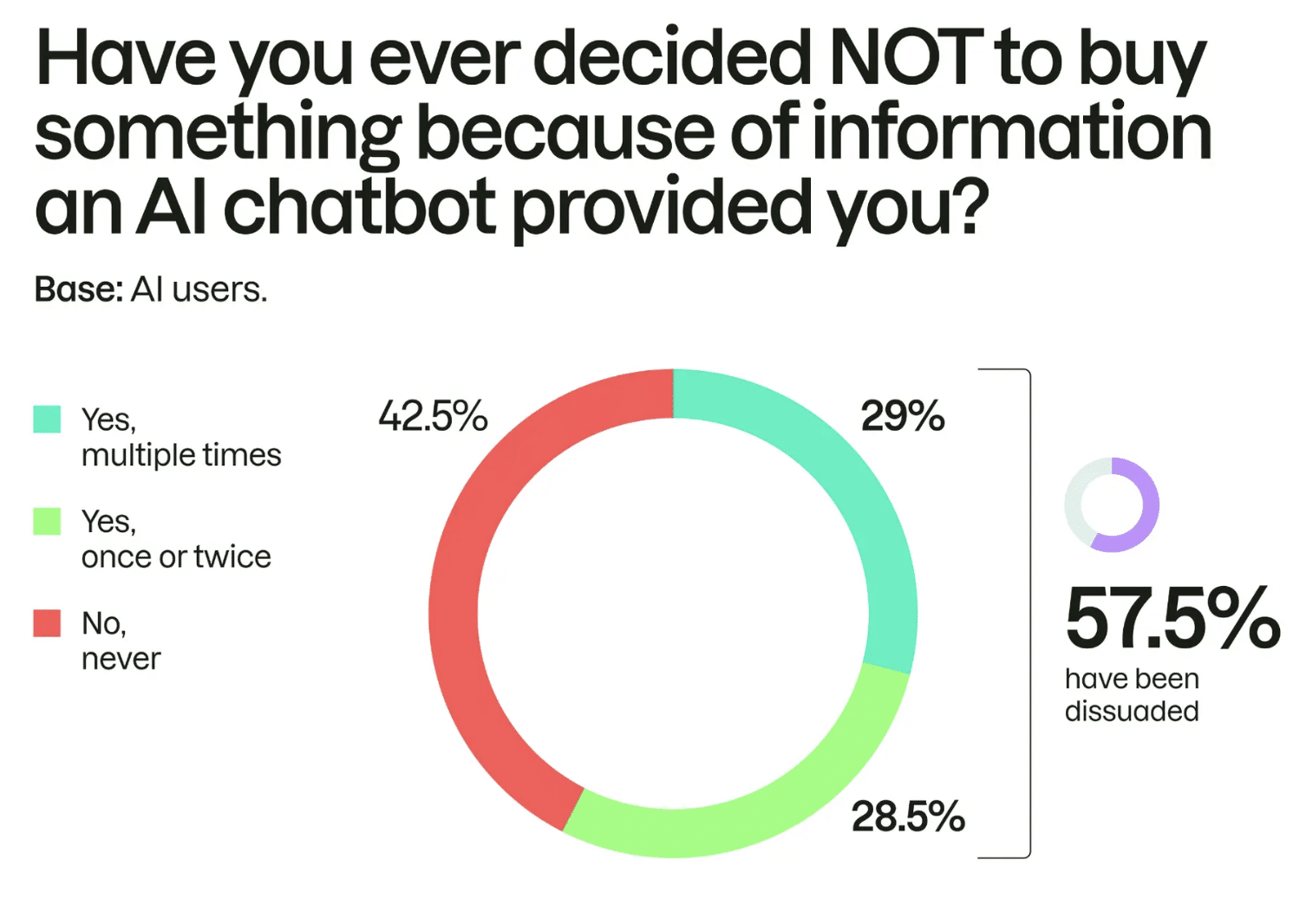
More than half of consumers who use AI have decided not to buy something based on information from a chatbot, according to a new Semrush survey. Among people who use chatbots when shopping online, nearly 81% have decided against a purchase based on AI guidance.
That creates a problem for marketers that goes beyond getting their products into AI answers. A chatbot can introduce someone to your brand, but it can also give that same person a reason to cross you off the list, according to a new Semrush survey of 2,338 U.S. adults.
AI recommendations work both ways
AI can be pretty persuasive in either direction. About 58% of AI users have bought something recommended by a chatbot, while the same percentage have decided against a purchase based on information it provided. Among people who use AI multiple times a week, more than 80% have bought an AI-recommended product.
Reviews can make the downside particularly painful. More than 74% of all consumers said they would be at least somewhat less likely to buy a product if a chatbot surfaced mixed or negative reviews. Among AI users, that jumps to more than 85%.
At the same time, nearly 59% of AI users have discovered a new brand or product through a chatbot recommendation, and about 71% believe chatbots can recommend the best brands and products. So AI can put your product on the shopping list and then provide the information that takes it right back off.
AI is taking some searches without replacing Google
This isn’t about consumers abandoning Google for ChatGPT. Only 29% of all consumers use AI chatbots for product research. Among people who use AI at least weekly, that rises to 55%. For that group, chatbots are already used more than friends and family, social media, retail websites, and YouTube for product research. Search engines and reviews still rank higher.
And while 65% of AI users said chatbots have replaced at least some of their product-related Google searches, nearly half said their overall Google usage for purchase research hasn’t changed over the past year.
So marketers aren’t watching one channel replace another. They’re watching another channel get added to the mix. A shopper can bounce among Google, reviews, websites, and AI during the same purchase decision, giving a brand another place to gain or lose consideration.
Paying for visibility doesn’t solve the problem
The obvious response might be to buy ads inside chatbots. That gets you visibility, but it doesn’t determine what the chatbot says five minutes later when someone asks whether your product is any good.
There’s also a potential trust problem. About 42% of consumers dislike chatbot ads, compared with 20% who like them and 38% who are neutral. Among those who dislike them, 66% said ads make them question the integrity of AI responses.
That’s the tricky part for marketers. You can pay to put your brand in front of someone, but you can’t buy the answer they get when they ask how your product compares with a competitor, whether customers have had problems with it, or whether it’s worth the price.
Consumers aren’t just asking AI what to buy. They’re asking whether they should buy from you at all.
The full study can be found here. (No registration required)
Disclosure: Semrush is the parent company of MarTech.
The world’s most powerful SEO platform, purpose-built for Enterprise.
This text was published by MarTech and written by Constantine von Hoffman. It is reproduced here with attribution so you can read it in full; the rights remain with the publisher. Read it at the source ↗
The headline, key points and digest above were generated by Digest AI's editorial model from the linked sources. Automated summaries can contain errors: the sources are the record. Spotted a mistake? Tell us.
More in Marketing & Small Business
All →- Opinion: five‑person AI team in ChatGPT can ease busywork · 2 src
- Opinion: faster AI can highlight and worsen marketing workflow bottlenecks · 1 src
- ChatGPT adds blank line prompt for completing lists and sentences · 1 src
- Zapier lists eight AI sales assistant tools for 2026 · 1 src
- META Stock Surges 10% After Muse AI Agent Launch · 4 src
Comments
via GitHub Discussions