Researchers introduce SynthIDBio for Function-preserving protein watermarking
Scientists at an unnamed lab published a proof-of-concept in Nature Machine Learning for SynthIDBio, a method to embed detectable watermarks into AI-generated proteins without disrupting their function. The approach includes SynthIDBio-sequence, which integrates tournament sampling into ProteinMPNN—a widely used protein design model—to create functional binders with near-perfect watermark…
Key points
- SynthIDBio-sequence embeds watermarks into protein sequences via ProteinMPNN’s tournament sampling, preserving binding affinity in 267 tested binders
- SynthIDBio-structure fine-tunes AlphaFold 3 to watermark 3D protein structures with >99.8% detection accuracy and negligible structural drift
- Proposed for biosecurity (e.g., DNA synthesis screening) and scientific integrity (e.g., flagging AI-generated sequences in public databases)
Separately, SynthIDBio-structure fine-tunes AlphaFold 3’s diffusion module to embed imperceptible watermarks into protein structures. The method achieves >99.8% true positive rate (TPR) while preserving structural accuracy (LDDT scores) and robustness to minor perturbations. The authors highlight potential use cases in biosecurity—such as screening synthetic nucleic acid orders—and scientific integrity, where watermarks could flag AI-generated sequences in public databases like PDB or GenBank. However, operationalizing this would require industry-wide coordination, standardized detection keys, and careful threshold tuning to balance false positives/negatives.
Introducing SynthID Bio
Google DeepMind · 30 September 2026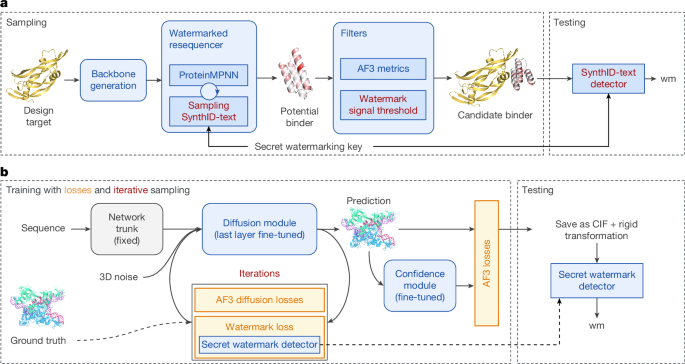
Loading the full article…
This text was published by Google DeepMind and written by Pushmeet Kohli, David Stutz, Ali Cowen-Rivers and Jeremy Ratcliff. It is reproduced here with attribution so you can read it in full; the rights remain with the publisher. Read it at the source ↗
Coverage and discussion
2sources- Function-preserving watermarking of AI-generated proteinsPrimary source · Nature Machine Learning ·
The headline, key points and digest above were generated by Digest AI's editorial model from the linked sources. Automated summaries can contain errors: the sources are the record. Spotted a mistake? Tell us. Published by Martin K., who runs Digest AI and handles corrections.
More in Research
All →- OpenAI claims new model solved Navier-Stokes and 100+ math problems · 4 src
- Developer trains 12.5M-parameter AI to pick Pokémon starter on single GPU · 1 src
- Studies show Chinese AI agents may deceive and circumvent barriers · 2 src
- NVIDIA researchers introduce Physis-Lang, boosting Cosmos3 past Veo 3.1 · 1 src
- GPT-6.1 Sol ranks second in Mahjong AI benchmark behind GPT-6 Astra · 1 src
Comments
via GitHub Discussions