Icarus Robotics tests free‑flying ISS robot JOY on 66 parabolic flights
Icarus Robotics reported that its free‑flying robot JOY completed 66 parabolas over four flights from Sept. 9 to 11, providing roughly two minutes of weightlessness. The tests focused on three core systems—manipulation, state estimation and flight control—and showed the seven‑degree‑of‑freedom arms and adaptive pinch gripper performed as expected. Because the team could not teleoperate the robot…
Key points
- JOY completed 66 parabolas across four flights, delivering about 2 minutes of microgravity.
- Icarus aims to hand over JOY to NASA on Jan 25 2027 for ISS deployment in May 2027.
- The robot uses seven‑DoF arms, adaptive pinch grippers, and an NVIDIA Jetson T5000 compute module.
The company plans to hand over JOY to NASA on Jan. 25, 2027, after which NASA will launch the robot to the International Space Station as Joyride‑1 in May 2027. JOY will initially be teleoperated and later gain autonomy as data are collected in orbit. Icarus built the arms in‑house and powers the robot with an NVIDIA Jetson T5000 module, offering far more compute than earlier ISS free‑flyers such as Astrobee. The startup, based in Brooklyn, raised $6.1 million in seed funding last year and is finalizing flight hardware for the upcoming NASA handover.
Icarus Robotics flies ISS-bound robot in microgravity for the first time
The Robot Report · 18 September 2026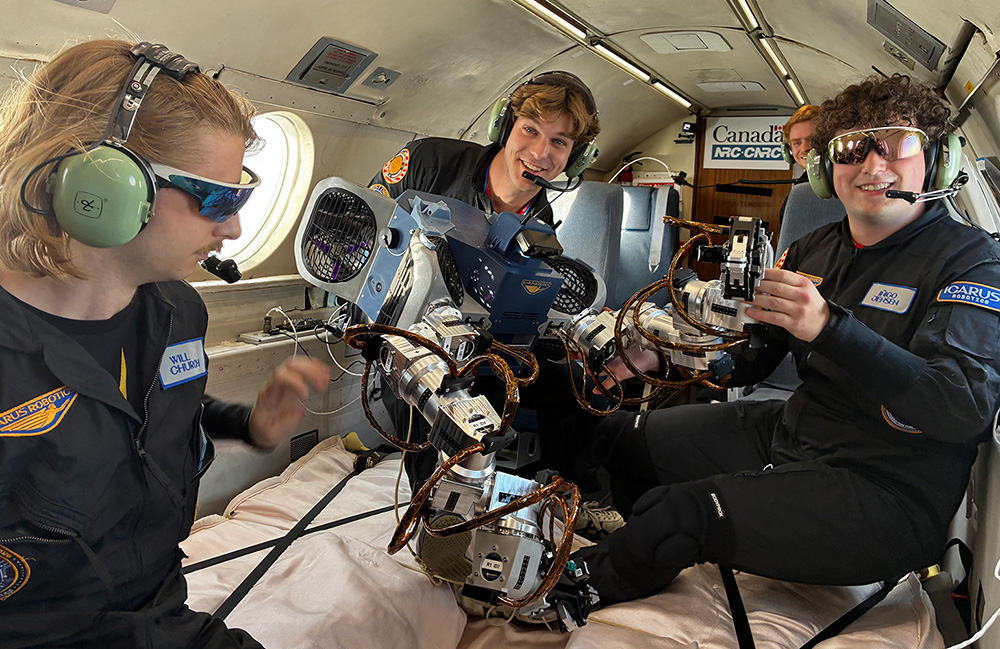
Icarus Robotics yesterday said it has tested JOY, its free-flying robot, on four parabolic flights from Sept. 9 to 11. In total, JOY flew 66 parabolas across four flights, resulting in 2 cumulative minutes of weightlessness.
JOY is a free-flying robot with robotic arms and finger pinch grippers. Icarus created the system to move through the pressurized interior of the International Space Station (ISS) and handle the cargo and logistics work that consumes much of astronauts’ time.
The company said its robot will be launched to the ISS in 2027 as Joyride-1, under a mission management agreement with Voyager Technologies announced in March. The flights were the last major test before Icarus finalizes JOY’s flight hardware for handover to NASA in January.
“It’s a very surreal thing to be building toward that, and we have been talking about it for over a year,” Ethan Barajas, co-founder and CEO of Icarus Robotics, told The Robot Report. “Now we have the confidence to go into January and say that this robot that we will hand over to NASA will operate in the way that we want in microgravity on the ISS.”
“We had stretch goals, and we had minimal viable success criteria,” he added. “Throughout this entire week, we hit all of those.”
Icarus Robotics’ stated goal is to free up astronauts so they can focus on higher-value research and mission objectives. Last year, the Brooklyn, N.Y.-based startup raised $6.1 million in seed funding. Since then, it has worked to turn its system into a scalable, production-ready robot.
Icarus Robotics tests three core systems in JOY
Parabolic flight is the only way to produce real microgravity without going to orbit. During these flights, the aircraft arcs over the top of a steep climb, giving everything inside roughly 20 seconds of weightlessness per parabola.
Icarus Robotics said it focused on testing three major systems within JOY: its manipulation, state estimation, and flight control.
“We had essentially four flights across the week, and then we chose to isolate different systems across the different flights. About half of our campaign was based around essentially testing the manipulation system,” explained Jamie Palmer, co-founder and chief technology officer of Icarus. “The arms themselves we were the most happy with. It was one of the biggest unknowns and one of the hardest things to model in the simulator.”
Icarus has built JOY’s robotic arms entirely in-house. They feature seven degrees of freedom (DoF) and an adaptive pinch gripper. Palmer said the team didn’t expect to get everything right the first time, but it was pleasantly surprised by the progress.
“We tested a suite of different controllers. We tested a suite of different trajectories, a suite of different movements,” he said. “We‘re pretty happy with the result. We were disturbing the arms and seeing their ability to come back to where they were supposed to come back to.”
Icarus plans to teleoperate its robots when they arrive at the ISS and develop an autonomy system over time as it gathers data in space. During the test flights, however, the team couldn’t teleoperate its robots, so it had to get creative.
“We couldn’t teleop like we’re going to be able to do on the space station,” said Palmer. “So, what we were doing is taking these pre-recorded teleop trajectories and pre-recorded set points. We were able to go do these terrestrially in our office, take that data, and then run the same thing in microgravity, benchmark it, and compare those two things.”
Getting flight right in short windows to zero-G
State estimation and flight control both have to do with how JOY moves around in space.
“In some of the videos, you might see us actually physically moving the robot with our hands, and that’s when we’re testing the state estimator before we go into the flight control, because of course you want to make sure that your state estimation is good before you start running a controller off the back of it,” said Palmer. “Again, that held up pretty well.”
Flight control was actually more challenging to get a handle on during the tests than it will be on the ISS, he noted.
“What was operationally challenging was when we went to test the flight control,” said Palmer. “This being our first time doing a parabolic flight, we learned about the settling period when you’re actually getting into microgravity. You’re coming down and your plan is banking and diving. This causes variances in the microgravity environment that the team won’t experience when it sends JOY to the ISS.”
“We were very conservative in the amount of time we were going to run our robot and the flight controller during the parabola because it’s an operationally challenging thing to do,” he recalled. “You have to have operators catch it, restrain it, release it, and during that G variance as well, we spent a lot of time sort of settling.”
Palmer said Icarus hopes to get more aggressive during future flights to push the system to its limits.
Space developers seek out Canadian partners for flights
Icarus had to do this particular campaign in Canada, despite the fact that it has plans to work with NASA in 2027. This is because the only only U.S.-based parabolic flight operator is currently suspended. So, American companies building hardware for microgravity now have to leave the country to prove it works.
Barajas said this created some challenges for the Icarus team. “It was our plan to go with that provider. It’s in America. It’s easy for us to get to. As soon as we started talking to them and found out that their plane wasn’t flying, we immediately had to look for other options,” Barajas said.
Icarus likely isn’t the only company having to seek out other options. And, in the end, fewer parabolic flight operators creates a bottleneck in testing technology for space.
“When you talk to the NRC [the National Research Council of Canada] and you talk to some people running these zero G flights in France, in Japan, in Zurich, wherever it might be, you realize there’s a lot of demand, and a lot of demand is moved from the U.S. to these other places, just because there isn’t a provider. With that, timelines get longer and longer,” Barajas said.
What comes next for Icarus?
For now, Icarus Robotics will be studying the results of its tests and applying corrections to JOY.
“There will be big performance upgrades coming to the software. There’s plenty of operational stuff that we would like to fine tune and finish by the time we get to the space station,” Palmer said. “Fortunately, no major overhauls of any systems that we need to see to today, which I think is a good takeaway.”
Right now, Icarus plans to hand over JOY is NASA on Jan. 25, 2027. In May, NASA plans to send the robot to the ISS, where the robot will do everyday tasks for astronauts so they can focus on more important work. Of course, these dates are subject to change according to NASA’s schedule.
Palmer and Barajas that emphasized JOY isn’t the same as Astrobee or any other free-flying robots that have operated aboard the ISS.
“It’s a very different capability than what we’ve seen in the past with Astrobee and other free flyers. Where they use cell phone compute, we’re using a T5000 from NVIDIA Jetson Thor,” Barajas said. “When you have that much headroom, you can do so much more. Our platform is built for manipulation, not just the camera, and to speak to people and to do flight trajectories.”
“A big takeaway for us is that this is probably one of the most complex robots that’s ever been to microgravity,” Palmer said. “We’re able to take advantage of all the terrestrial advancements that have happened over the last 10 years in both hardware and software. That’s just an insane leap that we’ve taken on Earth here in robotics, and I think we’re going to be the first people to bring that to space.”
This text was published by The Robot Report and written by Brianna Wessling. It is reproduced here with attribution so you can read it in full; the rights remain with the publisher. Read it at the source ↗
The headline, key points and digest above were generated by Digest AI's editorial model from the linked sources. Automated summaries can contain errors: the sources are the record. Spotted a mistake? Tell us.
More in Robotics & Physical AI
All →- Agility Robotics unveils Digit 5, a safer humanoid that crouches when humans approach · 1 src
- Waymo plans Singapore ride-hailing launch for 2028 with Jaguar I-PACE fleet · 1 src
- Figure unveils Helix 2.5 humanoid robot, achieving 56% zero-shot success in 30 homes · 1 src
- Arm launches Total Design for Physical AI, uniting 80+ developers · 1 src
- Agility Robotics unveils Digit 5, a humanoid worker with safety, lift and 20‑hour runtime · 5 src
Comments
via GitHub Discussions