Intel says AI demand outpaces wafer capacity, can only double output
Intel’s leadership, including CTO Pushkar Ranade, warned that AI compute has been growing three‑times per year for the past decade and that the company could at most double its leading‑edge wafer production with the current global stock of chip‑making tools. The shortage is driven by a mismatch between surging AI workloads and the limited number of EUV lithography machines from suppliers such as…
Key points
- AI compute has grown three‑times per year for a decade, outpacing Intel's wafer capacity
- Intel’s 14A node uses High‑NA EUV (NA 0.55) costing about $200 million per machine, printing 1.7 × smaller features
- 10 nm launch slipped from 2016 to 2018, prompting Intel to limit innovation per node to stay on schedule
The interview covered lessons from Intel’s delayed 10 nm node, which was slated for 2016 but did not enter volume production until 2018, and how those delays shaped the company’s approach to new technologies. Intel is now using High‑NA EUV (numerical aperture 0.55) for its 14A process, a tool that costs about $200 million per unit and is roughly twice the price of standard EUV machines, but it can print features 1.7 × smaller and reduce multi‑pass patterning. Backside power routing and gate‑all‑around transistors are also being introduced to improve density and performance.
The discussion also touched on Intel’s transition to a foundry model, the maturity of its process‑design kits (PDKs) for customers, and the ongoing “Hot Topics” meetings where engineers prioritize yield‑improving experiments. Executives acknowledged that, without additional equipment, scaling wafer output further will remain a bottleneck for meeting AI demand.
An interview with Intel's leadership, including CTO Pushkar Ranade, on AI chip demand, lessons from 10nm, whether Intel can catch up to TSMC, Terafab, and more
dwarkesh.com · 23 October 2026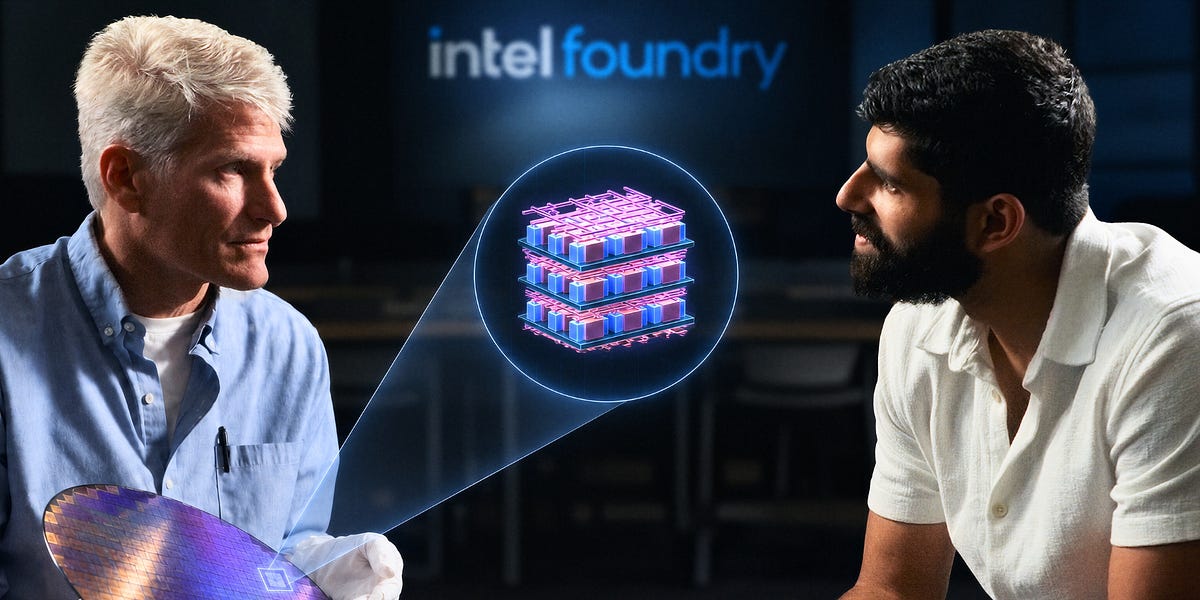
Loading the full article…
This text was published by dwarkesh.com and written by Dwarkesh Patel. It is reproduced here with attribution so you can read it in full; the rights remain with the publisher. Read it at the source ↗
The headline, key points and digest above were generated by Digest AI's editorial model from the linked sources. Automated summaries can contain errors: the sources are the record. Spotted a mistake? Tell us. Published by Martin K., who runs Digest AI and handles corrections.
More in Hardware & Compute
All →- Lava says it identified 32 Nvidia Blackwell Ultra B300 GPUs in China Telecom network · 1 src
- Nvidia DSX platform enables companies to overcome power bottleneck in AI factories · 2 src
- ASUS offers ProArt P16 laptop with NVIDIA RTX Spark, starting at $2,800 · 1 src
- Nvidia CEO Jensen Huang unveils DSX POD to cut AI data center deployment from months to 14 days · 19 src
- AI can speed up hardware prototype cycles for startups · 1 src
Comments
via GitHub Discussions