Perplexity trains agent on real mistakes with Hint-Guided Self-Distillation
Perplexity Research published a study on a new post-training method for its agent inside Perplexity Computer. The approach uses rejection sampling fine-tuning combined with hint-guided self-distillation to improve tool-call accuracy. In a live A/B test, tool-call failures dropped from 2.24% to 1.77% between two trained checkpoints, marking a 21.2% relative reduction the company calls…
Key points
- Perplexity’s agent training method reduces tool-call failures from 2.24% to 1.77% in live tests, a 21.2% relative drop
- Hints—short corrective instructions—guide self-distillation by comparing teacher (with hint) and student (without) model outputs
- Base model GLM 5.2 remains open on Hugging Face, but post-trained weights and code are not released
The method distinguishes between successful and failed sessions, applying cross-entropy loss to correct turns in successful sessions and KL divergence loss to error turns with validated hints. Hints are short corrective instructions grounded in the model’s existing knowledge. Perplexity notes the base model, GLM 5.2, remains openly available on Hugging Face, but the post-trained weights and training code are not released. Offline tool-error rates fell from 2.79% for stock GLM 5.2 to 1.35% with rejection sampling fine-tuning alone, and further to 0.87% with the combined approach. However, live user dissatisfaction rates showed no significant change, remaining around 2.58% to 2.54%.
The study excludes sessions with personally identifiable information and uses LLM judges to validate task difficulty and root-cause analysis of complaints. Perplexity emphasizes that hints improve model behavior before training, with the base model avoiding original failures in 93.7% of held-out tool-error turns when provided with hints.
Perplexity Trains Its Computer Agent on Real Mistakes With Hint-Guided Self-Distillation
MarkTechPost · 25 September 2026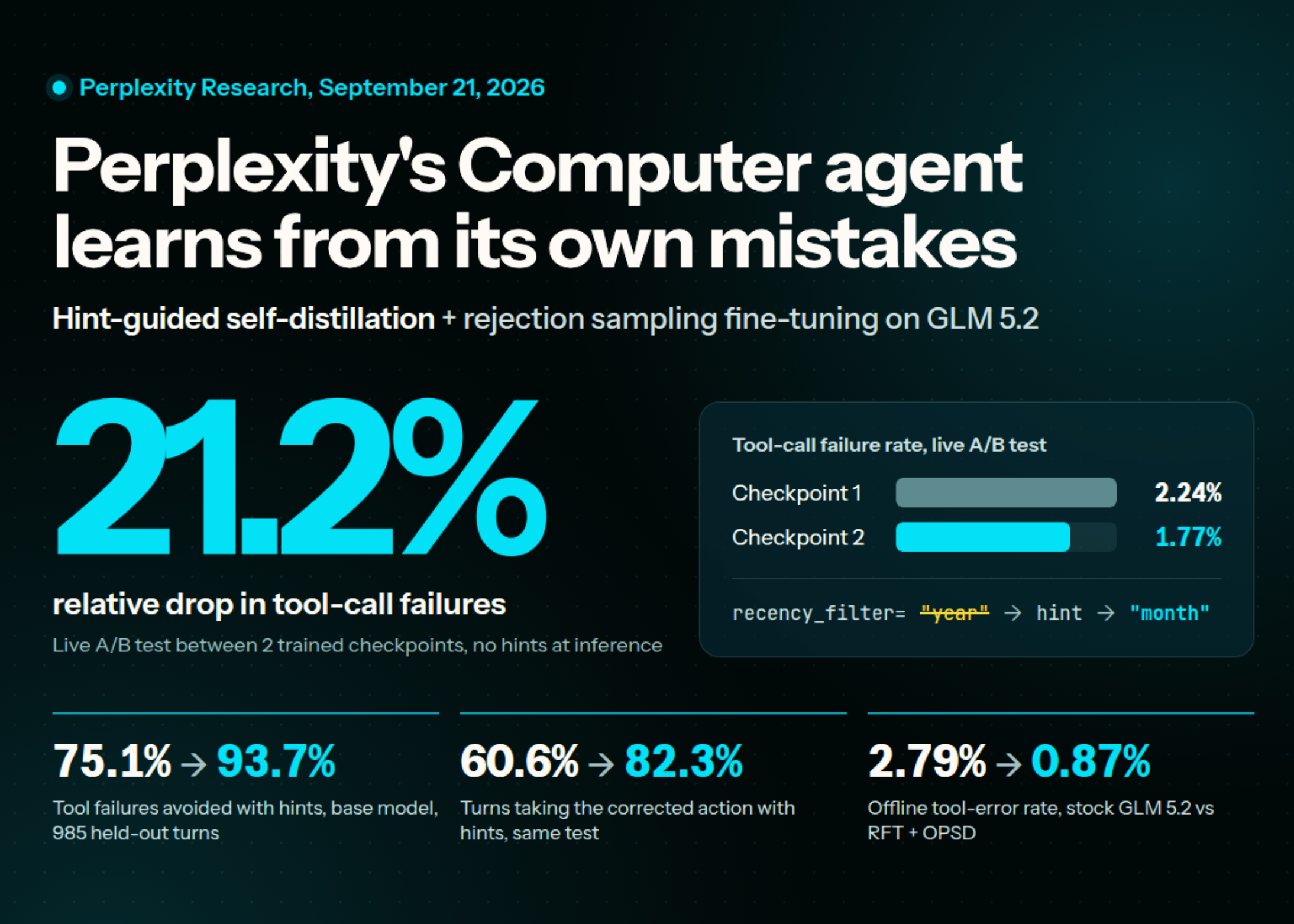
Loading the full article…
This text was published by MarkTechPost and written by Michal Sutter. It is reproduced here with attribution so you can read it in full; the rights remain with the publisher. Read it at the source ↗
The headline, key points and digest above were generated by Digest AI's editorial model from the linked sources. Automated summaries can contain errors: the sources are the record. Spotted a mistake? Tell us. Published by Martin K., who runs Digest AI and handles corrections.
More in Agents & Tools
All →- Apple Intelligence for Home costs up to three times more than Ring and Nest in tests · 1 src
- Author tests RAG and agents separately, finds a middle layer improves task success · 1 src
- Multi-agent systems split tasks across AI agents for better results · 1 src
- Google launches Call for Me feature for Gemini on Pixel 11 in the US · 6 src
- Claude Tag now supports personal connectors in channels · 1 src
Comments
via GitHub Discussions