Koppar's AI-designed USB-C LTE modem makes calls
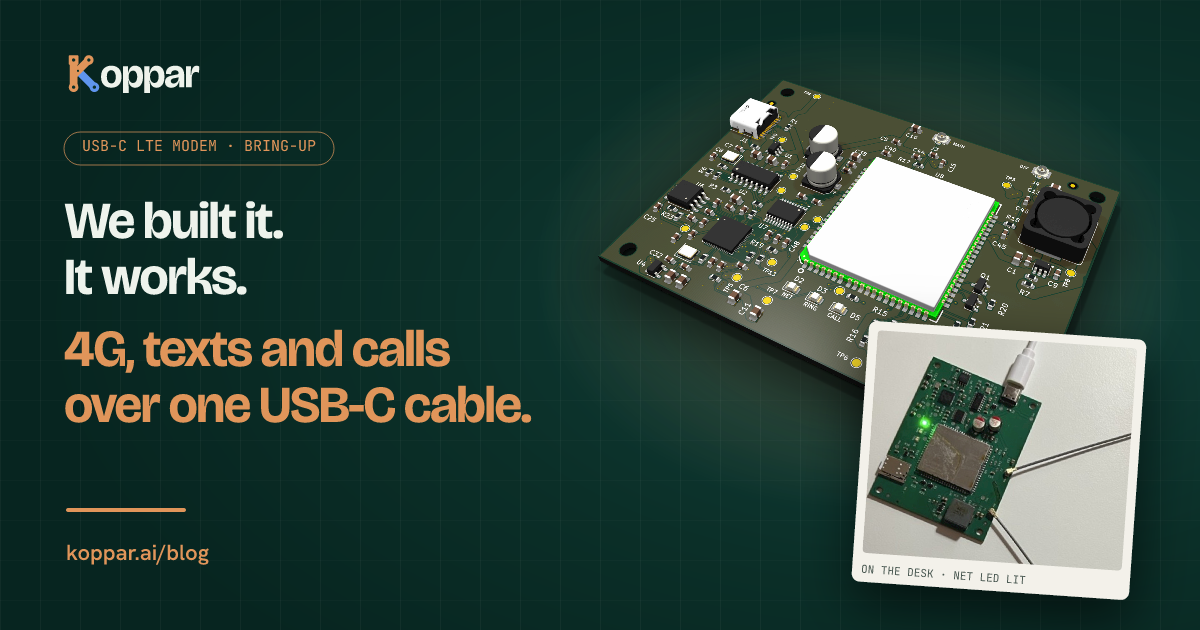
Koppar has successfully built and tested a USB-C LTE modem designed by its AI agent from a one-page specification. The 4-layer board, featuring a Quectel EC25-EUX module and an RP2040 microcontroller, registers on 4G networks, sends texts, and handles voice calls using a computer's microphone and speakers.
Key points
- Koppar's AI-designed LTE modem registers on 4G, texts, and makes calls on a Mac.
- Five of six frontier models failed to match the AI-designed board's layout quality in RealPCB tests.
- The open-source design requires manual soldering of the Quectel EC25-EUX module as it is not on JLCPCB's line.
The team assembled the board at JLCPCB and manually soldered the cellular module, resolving several issues including USB reset bugs and missing recovery pads.
The project serves as a reference for RealPCB, a benchmark by Esuna Labs that evaluates AI agents on laying out production circuit boards. In tests, five of six frontier models failed to match the quality of the layout released by Koppar's engineer, despite starting with placed parts. The design is open hardware under the CERN-OHL-P-2.0 license, with all files available in a public repository. The team notes that while the AI handled the initial design, human review was essential to catch 12 critical errors, such as incorrect antenna feeds and SIM socket orientation.
This demonstration highlights the current limits of AI in hardware design, showing that while agents can generate functional schematics, they still require significant human oversight for production-ready quality. The project includes a macOS menu-bar app, Koppar Phone, for managing calls and texts, and the team is planning a Rev C with improved recovery options and signed firmware updates.
Coverage and discussion
1source- Hacker News discussion · 42 pointsnews.ycombinator.com
The headline, key points and digest above were generated by Digest AI's editorial model from the linked sources. Automated summaries can contain errors: the sources are the record. Spotted a mistake? Tell us. Published by Martin K., who runs Digest AI and handles corrections.
More in Hardware & Compute
All →- SpaceX aims to add 10 GW of AI compute by end of 2027, Musk says · 1 src
- Hugging Face launches llama.cpp benchmark dashboard for AMD Ryzen and Radeon hardware · 2 src
- Researcher explains why Nvidia’s GPUs dominate AI training · 2 src
- OpenAI and Cisco release Shirudo runtime to block AI-driven Linux exploits without reboots · 6 src
- Gigabyte reportedly fired Control Center team after AI found RGB bug · 1 src
Comments
via GitHub Discussions