NASA and IBM release open-source lunar foundation AI model
NASA and IBM Research announced the open‑source NASA‑IBM Lunar Foundation Model, a multimodal AI system pretrained from scratch on SomBench, a lunar dataset containing nearly two million co‑registered data bundles across 11 modalities and two spatial scales. The model integrates imagery, topography, illumination geometry, thermophysical properties, mineralogy, radar, gravity and other lunar…
Key points
- Model pretrained on SomBench, a multimodal lunar dataset of nearly two million bundles across 11 modalities
- Evaluated on crater detection, irregular mare patch segmentation, and polar ice prospectivity, matching or beating ImageNet‑pretrained baselines
- USRA’s Dr. Rachel Slank helped create benchmarks, identifying over 49,000 lunar craters; model released on Hugging Face
The model was evaluated on three downstream benchmarks—regional and meter‑scale crater detection, segmentation of irregular mare patches, and regression of lunar polar ice prospectivity—and matched or outperformed ImageNet‑pretrained baselines and a comparable model without lunar pretraining. USRA’s Dr. Rachel Slank contributed planetary‑science expertise, helped build the high‑resolution LROC NAC crater benchmark with more than 49,000 manually identified craters, and reviewed the study. The pretrained model, fine‑tuning code and benchmark datasets are released openly on Hugging Face for the planetary‑science and AI communities.
Model page: NASA-IBM Lunar Foundation Model →
NASA-IBM Lunar Foundation open-Source Geospatial AI Model
newsroom.usra.edu · 19 September 2026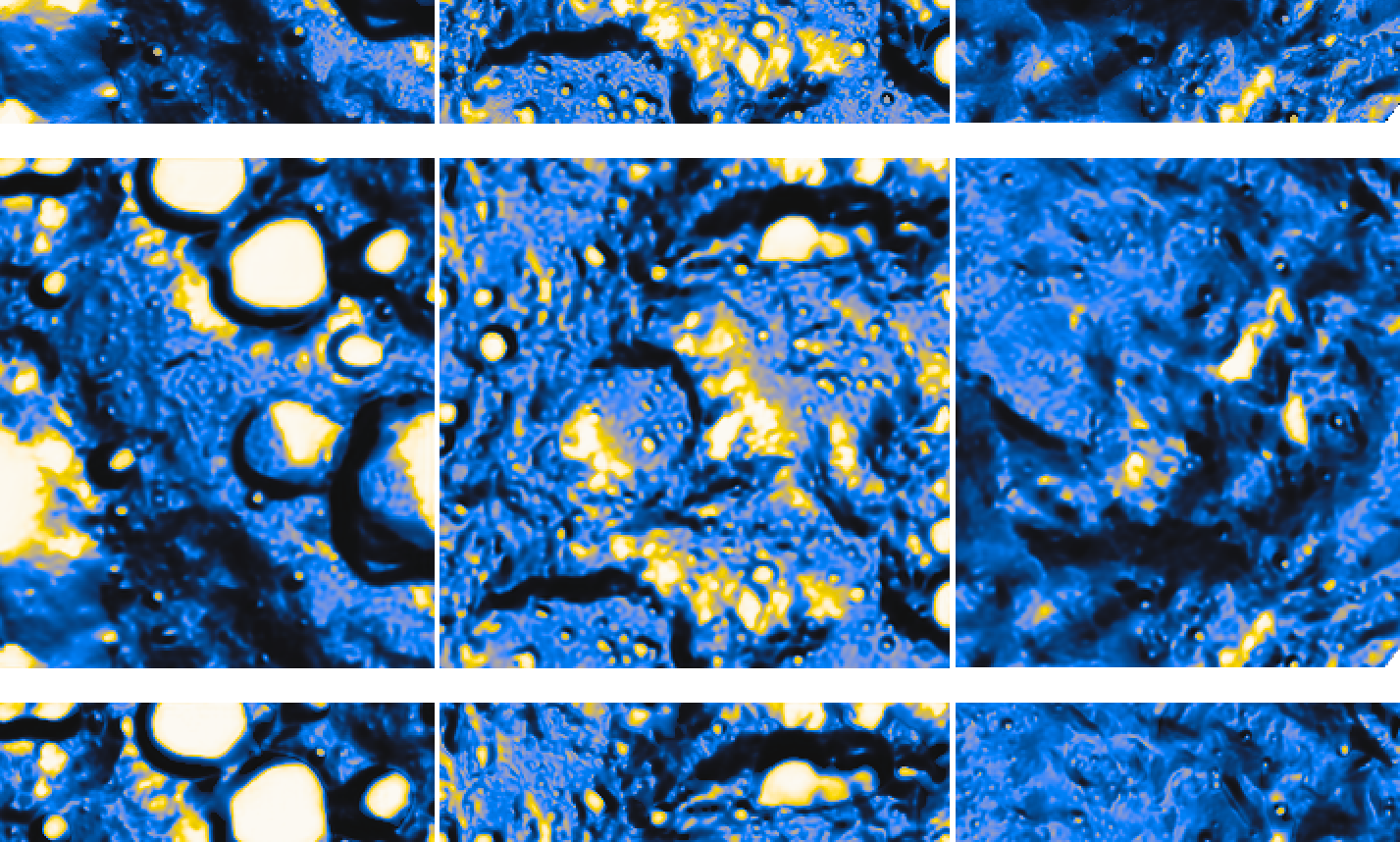
USRA Contributes Planetary Science Expertise to NASA-IBM Lunar Foundation Model
Open-source artificial intelligence model combines diverse lunar datasets to support scientific analysis of the Moon
WASHINGTON, D.C., — September 18, 2026. Universities Space Research Association (USRA) contributed planetary science expertise, lunar dataset development, and scientific evaluation to the newly released NASA-IBM Lunar Foundation Model, an open-source artificial intelligence (AI) model designed to help researchers analyze the large, diverse datasets collected by lunar missions.
Developed through a collaboration led by NASA and IBM Research, the NASA-IBM Lunar Foundation Model was pretrained from scratch using SomBench, a multimodal lunar dataset containing nearly two million co-registered data bundles spanning 11 modalities and two spatial scales. The model brings together complementary information about the lunar surface, including imagery, topography, illumination geometry, thermophysical properties, mineralogy, radar, gravity, and other geologic and environmental data.
USRA's contribution to the project was provided by Dr. Rachel Slank, an associate scientist with USRA's Science and Technology Institute, on assignment at NASA’s Marshall Space Flight Center. She served as a planetary science subject-matter expert on the NASA-IBM Lunar Foundation Model team. Slank worked across both the science and modeling teams, helping connect lunar science priorities and the physical characteristics of planetary datasets with decisions about model development, applications, and evaluation.
The NASA-IBM Lunar Foundation Model was evaluated across three downstream benchmarks: crater detection at both regional and meter scales, segmentation of irregular mare patches (IMPs), and regression of lunar polar ice prospectivity. Together, these applications assess the model’s performance across a diverse range of lunar science challenges, from identifying impact features and mapping unusual volcanic landforms to integrating environmental datasets associated with the stability and potential distribution of polar volatiles.
Across all three benchmarks, the pretrained NASA-IBM Lunar Foundation Model matched or outperformed comparison models based on ImageNet pretraining, as well as an architecturally identical model initialized without lunar pretraining. The study also demonstrated particularly strong label efficiency in crater detection, suggesting that the representations learned through lunar pretraining can reduce the amount of task-specific labeled data required for certain applications.
The multimodal design of the NASA-IBM Lunar Foundation Model allows it to learn relationships among different types of lunar observations rather than treating each dataset independently. The model was designed to operate across both regional-scale Wide Angle Camera (WAC) observations and meter-scale Narrow Angle Camera (NAC) data while incorporating information such as terrain, illumination geometry, and other lunar surface properties.
By releasing the pretrained model, fine-tuning code, and benchmark datasets openly, the NASA-IBM Lunar Foundation Model team aims to provide the planetary science and AI communities with a reusable foundation for developing new lunar research applications.
A major component of this work was the collaborative development of SomBench, the dataset used both to pretrain the NASA-IBM Lunar Foundation Model and to support standardized evaluation of lunar machine learning (ML) applications.
SomBench contains two complementary components: a core multi-instrument dataset that serves as the pretraining corpus for the NASA-IBM Lunar Foundation Model and a suite of application benchmarks used to evaluate ML methods on representative lunar science problems. The benchmark suite addresses three broad science themes: impact processes, volcanic history, and polar volatiles.
As part of that effort, Slank led development of the high-resolution Lunar Reconnaissance Orbiter Camera (LROC) NAC crater benchmark, manually identifying more than 49,000 lunar craters. The resulting dataset uses high-resolution lunar imagery together with co-registered digital terrain models to evaluate crater detection at meter-scale resolution. She also contributed to the broader SomBench datasets and science applications and provided extensive scientific review of both the SomBench study and the NASA-IBM Lunar Foundation Model study.
“One of the biggest challenges was bringing together lunar datasets that span very different instruments and spatial resolutions (1m to 20km per pixel) while still preserving the scientific value of each dataset,” said Dr. Slank. “Because I worked across both the science and modeling teams, I could help make sure those differences were considered as the data was brought together and used to train and evaluate the foundation model. I can’t wait to see what new science researchers will be able to do with the help of the NASA-IBM Lunar Foundation Model!”
The NASA-IBM Lunar Foundation Model and associated datasets are available through Hugging Face.
NASA announcement:
IBM announcement:
About USRA
Founded in 1969, under the auspices of the National Academy of Sciences at the request of the U.S. Government, the Universities Space Research Association (USRA) is a nonprofit corporation chartered to advance space-related science, technology, and engineering. USRA operates scientific institutes and facilities and conducts other major research and educational programs under federal funding. It engages the university community and employs in-house scientific leadership, innovative research and development, and project management expertise.
More information about USRA is available at www.usra.edu.
This text was published by newsroom.usra.edu and written by Universities Space Research Association. It is reproduced here with attribution so you can read it in full; the rights remain with the publisher. Read it at the source ↗
Coverage and discussion
1source- Hacker News discussion · 42 pointsnews.ycombinator.com
The headline, key points and digest above were generated by Digest AI's editorial model from the linked sources. Automated summaries can contain errors: the sources are the record. Spotted a mistake? Tell us.
More in Generative AI & Models
All →- Linkup Research releases sparseup 149M-parameter sparse embedding model · 1 src
- Six Jev-inspired models released in two days, from Laya (421M params) to Kev-0.5B · 1 src
- MarkTechPost explains GGUF, GPTQ, AWQ, EXL2, EXL3 model formats · 1 src
- xAI releases Grok Voice Transcribe 2.0 speech-to-text model · 2 src
- Alibaba open-sources Damo Radar model to detect 146 abdominal conditions · 1 src
Comments
via GitHub Discussions